Showing posts with label Bible. Show all posts

Tuesday, March 18, 2025

Welcoming the Stranger

This deeply biblical insight on welcoming the stranger is challenging for us!

“This fundamental regard for the resident alien, and call to solidarity with the ‘outsider,’ came to full realization in the teaching and practice of Jesus of Nazareth.”

Check out the full article below.

Tuesday, June 11, 2024

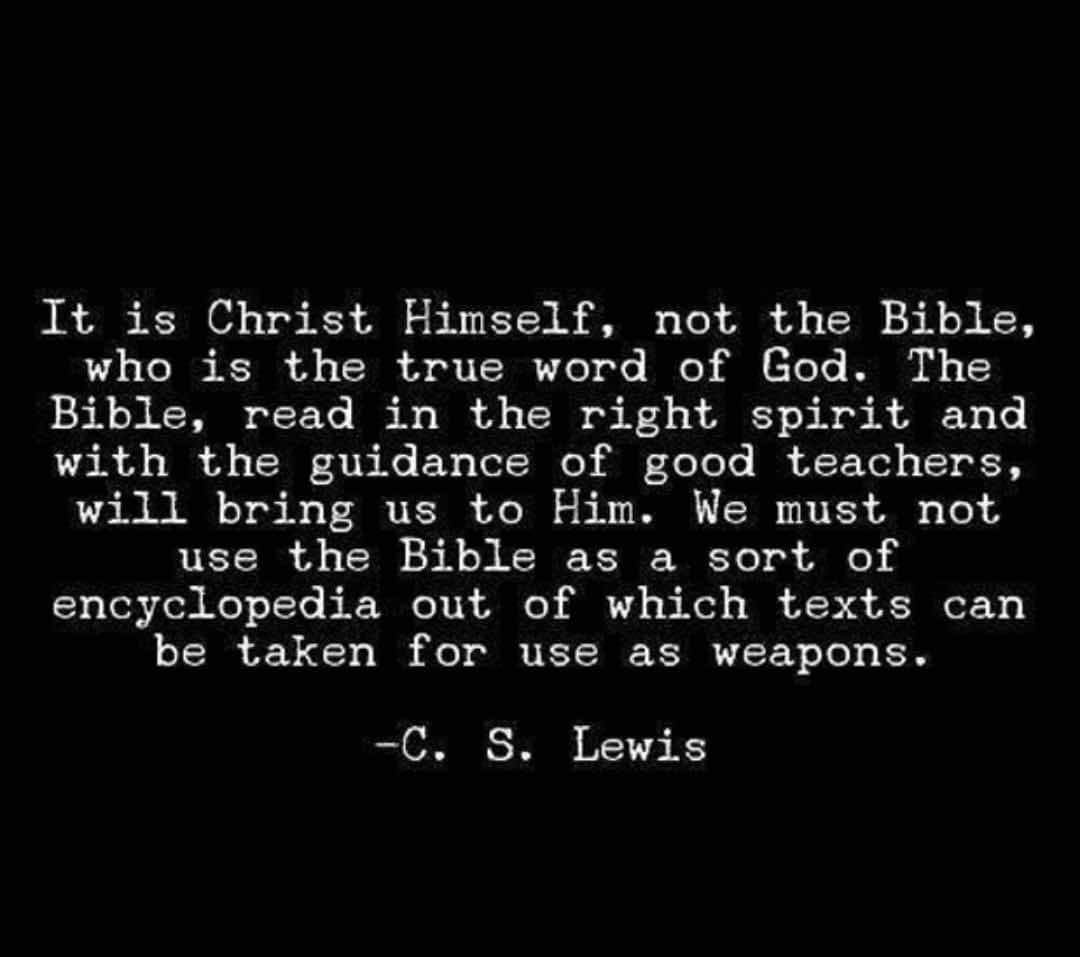
The Word of God


I believe this wholeheartedly. The Bible calls Jesus Christ the Word of God. “In the beginning was the Word, and the Word was with God, and the Word was God.”

There is a custom of referring to the Bible as the Word, but that’s not because it is the “words of God,” chiseled in stone and handed to us. It’s because scripture reveals to us the true Word, which is Christ. We don’t read it “flat” as if it’s all the same. No, it all points to Christ and we interpret it through Christ, the “exact imprint of God’s very being.”

I have been deeply disappointed in how the Bible has been cherry-picked with little context for justification of political opinions and separatism. God gave it to us as a “means of grace.”

Thank you, C.S. Lewis, for reminding me this is not new. May we come back to Christ through our adventures in the Bible. May the Holy Spirit lead us in our theological task of interpreting it through tradition, reason, and experience.

Sunday, June 9, 2024

"One Three Nine" by Aubrey Logan

To have a listen, click ONE THREE NINE.

I was excited that Psalm 139 came up in the lectionary. During the early days of the pandemic, I fell in love with the jazz of Aubrey Logan. She does trombone and vocals with a rhythmic fusion of jazz, pop, and rock, and sometimes her music has religious overtones (in addition to generally wholesome themes). I suspect she has a United Methodist background, because she has a number of times quoted things found in our hymnal. This selection is a good example.

I presented Aubrey Logan's "One Three Nine" in worship in June of 2024. I share it here in hopes that it helps you get in touch with the inescapable love of God through the words of Psalm 139.

Notice that she quotes "Oh, How I Love Jesus" at the beginning and the end. She didn't just do that because it's a pretty tune, she did it because it's a theological statement. She wraps the love of our Creator, who searches and knows us intricately, together with Christ in the last verse, in fact.

To have a listen, click ONE THREE NINE.


Thursday, May 23, 2024

The “Tax Collector Complex”


I have decided to call it the “tax collector complex.”

In Jesus’s time, the tax collector was like the “king of sinners,” the worst of the worst of the worst. Jews found them repulsive. They are even treated as their own special category (Jesus was asked “why do your followers eat with tax collectors and sinners?”).

Because of what it says in the Bible? No. Did some of them steal off the top? Of course, the Bible says they did. Did all of them? That’s highly unlikely.

They were repulsive to Pharisees but that’s absolutely and unequivocally about culture wars (the tax collectors collaborated with the Romans). That’s why Jesus told the story of the Pharisee who prayed “thank you that I’m not like that tax collector over there” … because that’s how repulsed they were.

Even if you believe homosexuality is a sin (which I do NOT, I believe homosexuality is an orientation you are born with, it is actions that can be sinful or not), why are people so hyper focused on it? The tax collector complex. That’s the only reasonable explanation.

Here’s a simple example. We offer plenty of grace regarding divorce and remarriage (which Jesus clearly called adultery, which by the way is in the 10 commandments), but there are folks who offer NO grace at all about being queer (which Jesus never mentions at all, EVER, and it’s NOT in the 10 commandments). I am not saying we should condemn divorce, not at all. I’m saying offering grace about divorce and remarriage, but not about being queer, can simply NOT be justified biblically. It’s culture wars, plain and simple.

I debated with Nigerian pastors over their views condemning the actions of General Conference. I kept asking, if they believed homosexuality is a sin and they also believe polygamy is a sin, then why were they so offended that we simply neutralized language in the Discipline about homosexuality, but they never, EVER insist on filling the Discipline with harmful language about polygamy?

They never could answer my question. Of course they can’t … because the only justification for the difference in attitude is the “tax collector complex.” I told them they were comfortable dealing with their own social issues regionally, but they were refusing to allow us to do the same.

Monday, May 13, 2024

John 17

The lectionary gospel for this past Sunday was from John 17. In my sermon, I said something I've often said in the past couple of years.

“Jesus never even mentions some of things people get so uptight about that they decide to split off from their own denomination. But he most definitely did talk about unity. That’s what he prayed for. We find our life together not by agreeing on everything, especially things that are secondary to the gospel and creeds and confessions of faith … but by abiding in HIM."

Tuesday, March 26, 2024

From Hostility to a New Home to a New Hope

I shared this week’s “Read Together” podcast for North Alabama United Methodists. Pondering the characters of Samson, Ruth, and Samuel in the books of Judges, Ruth, and 1 Samuel, it’s on politics and religion and “moving from hostility to a new home to a new hope.”

Have a listen:

Saturday, January 6, 2024

“This Gospel” of Radical Inclusion


Happy day of Epiphany!

Here’s a snapshot of Sandy when we were enjoying the Christmas lights at Calloway Gardens.

May the light shine and unfold for you the mystery of the ages, hidden in Christ and now revealed. Paul describes “this gospel” as one of radical inclusion (not just personal salvation) in Ephesians 3:5-10:

“In former generations this mystery was not made known to humankind, as it has now been revealed to his holy apostles and prophets by the Spirit: that is, the Gentiles have become fellow-heirs, members of the same body, and sharers in the promise in Christ Jesus through the gospel. Of this gospel I have become a servant according to the gift of God’s grace that was given to me by the working of his power. Although I am the very least of all the saints, this grace was given to me to bring to the Gentiles the news of the boundless riches of Christ, and to make everyone see what is the plan of the mystery hidden for ages in God who created all things; so that through the church the wisdom of God in its rich variety might now be made known to the rulers and authorities in the heavenly places.”

Wednesday, November 8, 2023

Jesus in the Morning

This might be a record.

I got nineteen minutes (count them, 19!) of their undivided attention at chapel for Kids 1st Academy today. And the best part is I got to answer the question one of them asked me last week after chapel, “who is Jesus?”

We learned the song “Jesus in the Morning,” so I just had to post my favorite picture of Jesus for all time (unless I’m mistaken it originated from Sally Allocca’s mother). We learned the Bible verse “For God so loved the world that he gave us his only Son.”

I got to introduce some people to Jesus today. What can be better than that?


Wednesday, February 9, 2022

Amazing Quote From the Late Rachel Held Evans


“They said that if I questioned a 6,000-year-old earth, I would question whether other parts of Scripture should be read scientifically and historically. 

They were right.  I did. 

They said that if I entertained the hope that those without access to the gospel might still be loved and saved by God, I would fall prey to the dangerous idea that God loves everyone,  that there is nothing God won’t do to reconcile all things to Himself. 

They were right. I have.  

They said that if I looked for Jesus beyond the party line, I could end up voting for liberals. 

They were right. I do (sometimes).  

They said that if I listened to my gay and lesbian neighbors, if I made room for them in my church and in my life, I could let grace get out of hand. 

They were right.  It has. 

They told me that this slippery slope would lead me away from God, that it would bring a swift end to my faith journey, that I’d be lost forever.

But with that one, they were wrong. 

Yes, the slippery slope brought doubts. Yes, the slippery slope brought change. Yes, the slippery slope brought danger and risk and unknowns. I am indeed more exposed to the elements out here, and at times it is hard to find my footing.  

But when I decided I wanted to follow Jesus as myself, with both my head and heart intact, the slippery slope was the only place I could find him, the only place I could engage my faith honestly. 

So down I went. 

It was easier before, when the path was wide and straight. 

But, truth be told, I was faking it.  I was pretending that things that didn’t make sense made sense, that things that didn’t feel right felt right.  To others, I appeared confident and in control, but faith felt as far away as friend who has grown distant and cold.

Now, every day is a risk. 

Now, I have no choice but to cling to faith and hope and love for dear life. 

Now, I have to keep a very close eye on Jesus, as he leads me through deep valleys and precarious peaks.  

But the view is better, and, for the first time in a long time, I am fully engaged in my faith. 

I am alive. 

I am dependent.

I am following Jesus as me—heart and head intact.  

And they were right.  All it took was a question or two to bring me here.”

- Rachel Held Evans 
(June 8, 1981 - May 4, 2019)

Tuesday, February 1, 2022

Podcast on “Come to me … ALL”


It was a joy to prepare and record the “Read Together” podcast this week. The introduction written by Lyn Cosby at the Conference Center says:

Rev. Steve West finds a recurring theme of inclusiveness in this week's reading list—prompting us to remind ourselves, all means all.

You can listen to it here.

Wednesday, December 22, 2021

The Four Christmas Words


It's occurred to me (after years of exploring the Christmas stories in the Bible every year) that if each unique gospel writer had one word for Christmas, they might be these words. May it bless you and your family during this holiest of weeks.

LINEAGE - Matthew's Christmas word might be just that, "lineage." Generally speaking, his gospel gift is summed up in his favorite phrase,"this was done in order to fulfill what was said by the prophets ..." His gift is to show us how Christmas, and Jesus in general, fulfills Old Testament longing. Unlike the other gospels, he starts with the genealogy of Jesus (outlining 14 generations from Abraham to David, 14 generations from David to the Babylonian exile, and 14 generations from the exile to the Messiah). His point is it was clearly the plan of God that Christ would come and fulfill the prophecy of being a Messiah from the house and lineage of King David. He quotes scripture about how the virgin birth fulfilled prophecy. Unlike the other gospels, he also has the story of the magi (I hate to mess with your Christmas decor, but we don't know that there were three of them and they didn't make it to the manger, they came to the house they were staying as late as a couple of years later). Again, this is about fulfillment of prophecy. Matthew's Christmas story is all about that.

LAUNCH - If Mark has a Christmas word, it might be "launch." Why? He launches right into the message of John the Baptist, who prepared the way for Jesus to show up in ministry. Yes, it's true ... he doesn't even talk about Christmas at all. This makes sense, in light of the general impetus of Mark. His favorite word in the gospel seems to be "immediately." Jesus is always going and doing, and the kingdom of God is ushering in. So it's not just that he launches into the message of John and Jesus without a single story about Christmas, he believes that Jesus is launching the kingdom of God into our midst without delay.

LOWLY - If Luke has a Christmas word, I suppose it would be "lowly." Ah, yes, most of the Christmas narrative is here in Luke, because of his general concern for the least, the last, and the lost ... for the oppressed and neglected (from woman to Gentiles to Samaritans, plus parables such as the lost sheep and the lost coin). It's no accident, then, that he would be the one to tell the story of the shepherds being visited by the angels, not to mention the details about the poverty and lack of influence of Joseph and Mary, and the fact that Jesus was born in a stable out back. All that is meant to point to something about God's favor for the poor and needy. Even the canticles (the songs of Elizabeth, Mary, Zechariah, and Simeon) are about both fulfillment of prophecy and about God's regard for the oppressed and the lowliness of his servants. For Luke, every aspect of the narrative is about this.

LOGOS - Well, if we are going to stay with the "L" theme it's obvious what John's Christmas word would be. It would be logos, the Greek New Testament word for, well, "word." He tells of Christmas as a poet, not a storyteller. We don't get from John details such as stables, local politics, or taxes, and there are no wise men or shepherds. Instead, it's rich and beautiful theology that has shaped our spirituality on every level. He starts out, "In the beginning was the Word, and the Word was with God, and the Word was God." Theologically, he describes how Christ is the very word God spoke to set creation into being. He muses on how this life was the light that shines in the darkness, which will never overcome it. John the Baptist is a "witness to the light," Then he says, "And the Word became flesh and dwelt among us," theologizing on the incarnation and the humanity/divinity of Christ. John's version of Christmas takes a deep theological plunge, even if it doesn't help with setting up your manger scene!

So, if you had a word for Christmas, what would yours be?

May you have a wonderful, wonder-full Christmas.

Wednesday, June 30, 2021

Coming to Communion in an “Unworthy Manner”


When I posted the attached picture on Facebook, I got a question from a friend. I succinctly responded to what I think is one of the biggest misinterpretations of Paul’s communion theology today. I thought it would be good to share it here as well.

Here was his question:

And what is your take of the following passage:1 Corinthians 11:29-31 Modern English Version (MEV)29 For he who eats and drinks unworthily, eats and drinks damnation to himself, not discerning the Lord’s body. 30 For this reason many are weak and unhealthy among you, and many die. 31 If we would judge ourselves, we would not be judged.

Here was my response:

That’s  a great question and the scriptural context makes the answer very clear with what Wesley called a “plain reading” of the text. I studied this in my doctoral work.

Paul is not talking about some sense of individual worth or personal morality as many have imagined, but rather he is talking about ethics within the community. The context of 1 Corinthians 11 is that there were divisions in the community (the whole book is about that starting with chapter 1), and in that very chapter 11, Paul was criticizing the way these divisions were made evident even when they gathered at communion (“when you gather, it’s not the Lord’s supper that you eat, for one goes hungry while the other is drunk”). They were not sharing their food and wine, they were not regarding one another with love, they were quite comfortable with the difference in status they had from each other.

What he saw at the communion table becomes a prism through which he looks at the lack of love for each other beneath the surface. He goes on in chapter 12 to teach them how each of them have different gifts, like parts of the body, therefore they should appreciate each other as valuable. Then he says “let me show you an even more excellent way,” and he goes to chapter 13 into the “love chapter” in which he describes what true love is (we like to read this at weddings but what he was addressing was spiritual arrogance and church conflict ... “if I speak in the tongues of people and angels but do not have love, I am nothing but a noisy gong”.) Then in chapter 14, he directly addresses the spiritual arrogance they had against each other. Chapters 11-14 should be read as one block of teaching.

Clearly, when Paul wrote what you quoted he was talking about how they treated each other without love and appreciation and a sense of community. That’s what coming to the table in an unworthy manner is. Not some human line drawn in the sand over what you believe or don’t believe, or what sin is bad enough and what isn’t.

Those who exclude people who earnestly seek God from the table may be the ones guilty of not coming to the table in a worthy manner.

He replied:

I've never heard of any of us Methodist Pastors excluding anyone, have you? 

I responded:

No, the open table is central to Wesleyan theology, you are right.

However, I have heard of Methodist ministers excluding people from membership or attendance or baptism, whether back during the 60’s or in recent days, and that is by proxy excluding them from the table. This is against our Discipline not to mention wrong.

Wednesday, April 7, 2021

Beth Moore Speaks Out


I’m a United Methodist, and I respect the faith of my brothers and sisters of other denominations.

But I agree with Beth Moore. I am glad to be part of a denomination that ordains women who are called by God and equipped by the Spirit, and that supports female leadership at all levels of local church life. In fact, the local church I presently serve has been greatly blessed by female clergy on the ministry staff in the past.

I believe the Bible is can be used to reinforce certain attitudes (against women, minorities, Jews, Catholics, the LGBTQ community, etc.) that go past the Bible’s original intent, instead of interpreting all scripture through the lens of Christ, the divine logos (Word of God).

Paul, in his New Testament writings, was simply pastoral and cautious at times, when in actuality the early church’s full inclusion of women was quite progressive for the times, following what was clearly the way of Jesus. His writings should be read in light of other things he wrote in scripture as well as interpreted through Christ.

You can find Beth Moore’s apology for supporting a theology of male dominance here.

Wednesday, March 24, 2021

Red Letter Christians

Today, I signed the "Red Letter Christians" pledge. I believe this with all my heart and life. You may want to consider signing it as well.

It is time for Christians to stand up for what is right, what is good, what is gospel. We aren't truly living as Christians unless we are on the journey of giving ourselves to the vision of the kingdom of God. If we do it not unto the least of these, we do it not for Christ. Be a part of the kingdom breaking into our world!

For more information, go here. A copy of the pledge is below.


I dedicate my life to Jesus, and commit to live as if Jesus meant the things he said in the “red letters” of Scripture.

I will allow Jesus and his teaching to shape my decisions and priorities.

I denounce belief-only Christianity and refuse to allow my faith to be a ticket into heaven and an excuse to ignore the suffering world around me.

I will seek first the Kingdom of God – on earth as it is in heaven – and live in a way that moves the world towards God’s dream, where the first are last and the last are first, where the poor are blessed and the peacemakers are the children of God, working towards a society where all are treated equally and resources shared equitably.

I recognize that I will fall short in my attempts to follow Jesus, and I trust in God’s grace and the community to catch me when I do.

I know that I cannot do this alone, so I commit to share this journey with others who are walking in the way of Jesus. I will surround myself with people who remind me of Jesus, help me become more like him and hold me accountable for my actions and words.

I will share Jesus with the world, with my words and with my deeds. Like Jesus, I will interrupt injustice, and stand up for the life and dignity of all. I will allow my life to point towards Christ, everywhere I go.

Tuesday, February 9, 2021

Praying the Psalms


I am so delighted to be part of a church that really believes in prayer.

I love the spirituality of diligently keeping up with a prayer list as a community and lifting those names not only in the newsletter, but as part of heartfelt Sunday morning prayers led by staff. I love the warmth and close proximity of the prayer room which focuses my prayerfulness before and after services, when I’m recording midweek devotions, and whenever I just need to go there to be still and know.

I also love the way this church is accustomed to making the psalms part of morning worship, as well as psalms being embedded in the lyrics of worship songs at Thrive. The psalms call our community to prayer. The psalms are the prayer book of the Church as well as of our ancestors in faith. Jesus had these prayers on his lips and in his heart. Christians keep praying the psalms, and will do so for the expanse of time, in ways that take prayer beyond words.

Whether our personal feelings at any given moment are articulated in a particular phrase, the psalms express the prayers and honest feelings of the whole Church across the world and across time. They give our prayers language and context. They connect us with the ongoing praise and prayer of all creation.

I ran across this good word in my morning devotions, from the martyr Dietrich Bonhoeffer whose deep and biblical spirituality led him to stand firmly against the realities of political evil. I share this with you today from his book Life Together.

“The Psalter is the vicarious prayer of Christ for his congregation. Now that Christ is with the Father, the new humanity of Christ - the body of Christ - on earth continues to pray his prayer to the end of time. This prayer belongs not only to the individual member, but to the whole body of Christ. All the things of which the Psalter speaks, which individuals can never fully comprehend and call their own, live only in the whole Christ. That is why the prayer of the Psalms belongs in the community in a special way. Even if a verse or a psalm is not my own prayer, it is nevertheless the prayer of another member of the community; and it is quite certainly the prayer of the truly human Jesus Christ and his body on earth.”

If you are new to praying the Psalms, spend time every morning for a few days praying Psalm 63. That’s a good place to start. Let the words sink in to the very depths of your soul and articulate your thirst for God.

Saturday, January 16, 2021

White Supremacy is Real


This is MLK, Jr. weekend when we observe one of the great Christian heroes of our time.

Racism in general, and white supremacy in particular, is something the Church must openly stand against. The insurrection against the capitol is a vivid reminder of just how dangerous it is to ignore the reality of extremist white supremacy in the US. The FBI has named it as our greatest domestic threat.
 
For the Church, calling out white supremacy is never about partisan politics. It’s about the gospel.

Jesus never mentions some of the things we get tied up in knots about in politics, so I consider those issues important, perhaps, but secondary because of the Word of God.

But no social issue is more centrally attached to the gospel of Jesus Christ than racism. Addressing issues related to conflict between Jews and Gentiles and Samaritans are everywhere in his ministry. Even gospel sermons in the early church follow the mode of Paul’s in Acts 13, where the good news of resurrection life was followed with the uncomfortable truth (for racist Jews of the time) that this good news was for both Jew and Gentile.

Stand against racism. Right now, it’s not enough to be personally not participating. We have to be faithfully anti-racist.

Years ago I published a column about this subject. In can be found on my blog here.

Wednesday, December 2, 2020

What is Truly Essential about Wesleyan Spirituality?


These are difficult times in North American Methodism. I don’t know what all the answers are related to moving forward, though I know unequivocally that I am not leaving my spiritual home.

I believe traditional, centrist, and progressive United Methodist are called to love and serve together and move forward in history, allowing diversity of thought and practices rather than drawing lines in the sand mirroring the culture wars of America, over issues that are not even mentioned in the gospels or the ancient creeds. It’s in our Wesleyan DNA to be connectional, and  it’s Christ’s vision for the Church evident in his prayer for us in John 17. We are indeed better together.

What is essential to Wesleyan spirituality that will guide us through these times and help us move forward together? I found an excellent article on this subject here and wanted to share it with you.

If you’d like to hear more about our efforts to stay in the UMC, see this website.

#stayumc

Wednesday, June 10, 2020

Wisdom for Difficult Times


This is my recent podcast on biblical wisdom for difficult times. In it, I reflect on Ecclesiastes 9:

“Go, eat your bread with enjoyment, and drink your wine with a merry heart ... Enjoy life with the wife whom you love, all the days of your vain life that are given you under the sun ... Whatever your hand finds to do, do it with your might.”

Here it is:

Friday, November 15, 2019

Bound by Love

“As a Christian, when confronted by a tension between a religious certainty which leads me to violate the law of love and a deep unknowing that still moves in the direction of ‘loving my neighbor as myself,’ I am bound to choose the latter course.”

Cynthia Bourgeault 

Friday, July 13, 2018

The High Roads and Low Roads Can Lead to God


This is my column which was published in The Arab Tribune on Wednesday, July 11, 2018.


Pictured are steps on the Perimenter Trail at Sewanee, in the section from Memorial Cross to Morgan’s Steep.


This summer, I took a course at Sewanee on images of God in scripture. One of our assignments was to choose a Biblical image and live with it for the summer. I discovered that sometimes you choose an image, and sometimes it chooses you.


I was pondering what in the world I was going to do for the class when I stumbled upon the Sewanee Natural Bridge (when I say I stumbled upon it, I mean that both literally and figuratively).


I had missed a turn and there it was, a massive bridge made of rock, as solid as ... a rock. It stood on the edge of the woods, a high stone path protruding from the ground. It’s stunning beauty resembled the ancient aqueducts of Greece. This path was not designed by utilitarian humans to go from one place to the next. It was crafted by our Creator to stand tall. It was indeed a “high” way, an enduring way.


Jesus said “I am the way.” It’s interesting that that the Greek for “way” in the New Testament almost always means something more tangible than what we think. It’s not just a method, process, procedure, or technique. It is a street or path, a roadside or route. The magi “returned to their county by another route.” “Take no bag for the journey,” Jesus said. They use the same word.


After standing in awe of the natural bridge for a few moments, I began to explore this high, stone path through the woods. I could easily walk under it and eventually climbed to the top to walk across it. It was immeasurable and immovable.


I do believe Christ is the way. It’s funny how people add the word “only” in front of that statement, as if he didn’t clarify his exclusivity enough. There’s not even a “the” in the Greek. Jesus said, “I am WAY.” He is the personification of the path, the embodiment of the expedition, the incarnation of the excursion. He’s a road trip indeed.


Sometimes the way of God is a “high road,” and sometimes the way is a “low road” (a hidden road, that is).


God as the “high road” is easy to imagine. Highway imagery is everywhere in the Bible. In Old Testament times, “highway” meant exactly that ... it was a road built up, raised from its surroundings so ruts and depressions did not become places where water collects. The technology we use now, including shaping a paved road so that the center is slightly higher than the edges to help with water runoff, has been around a long time.


In Biblical times, local roads were just beaten paths, so a highway was pretty special and took a lot of effort. “Build up the highway, clear it of stones,” Isaiah says in chapter 62. “Build up, build up, prepare the way, remove every obstruction from my people’s way” says Isaiah 57.


Sometimes I travel through through Birmingham, where two major interstates, I-65 and I-59/20, come together at what is not-so-affectionately called “spaghetti junction.” Not long ago an eighteen wheeler fell off the top ramp onto the highway below and exploded, making a huge mess. Finally, last year, they started reconstructing it.


I’ve always wanted them to fix it ... until now. It’s taking forever, and I miss a turn every other time I drive through there. Sudden darts of the car are required to manage the latest temporary turn lane.


I have no idea how road construction works, and trust me, I’ve been trying to figure out what they are doing at spaghetti junction. I’ve concluded that it’s way above my head (again, I’m speaking both literally and figuratively).


But what I have learned about road construction is this. It requires a whole lot of planning, design, and earthwork before you even start paving.


First, the building of a highway requires exhaustive plans by a relentless planner. Next the contractor builds embankments using cuts and fills. Then a grader or bulldozer comes and pushes dirt. Leveling the bumps and filling in dips creates a surface that will last.


After that, the screened dirt is sprayed with water and compacted. During this stage, they install drains and sewers. As I have said, the center of the road is made higher than the edges so water will run off. Drainage is critical for life expectancy of the pavement. All this work must then pass strict inspections.


Then the contractor places gravel in twelve–inch layers on the road bed. Workers moisten and compact each layer. Over and over, layers are added and compacted until the road bed reaches the height required. All of this is before anything is paved. Wow.


I also learned that road construction companies boast of what they call “Context Sensitive Solutions.” Context sensitive? God is that personal with you and with me. 


The psalmist sings, “lead me, O Lord, in your righteousness ... make your way straight before me.” God who is our path is also our pathmaker. God will diligently work to lay a road before you, perhaps especially for you. God is the chief strategist with a hard had, discerning and planning and analyzing all the way.


Like any smart road planner, God considers crash statistics when making a plan. And oh, do I ever have crash statistics on the road of my life. Yet with the diligence of grace, God makes a way.


Sometimes the way of God is a high road. But sometimes it’s a low road (a hidden path).


I have been fascinated by a Vermont government guide entitled “How to Find Ancient Roads.” Written for aspiring road historians, it gives guidance on how to find and map historic road locations that might just lie beneath your town.


I imagined using this guide to search for God, and the advice in the publication made perfect sense. It noted we should expect setbacks but “go back to it and find the rhythm in it.” It mentions that the project goes better if you have help from others in mapping it. It emphasizes keeping a journal and thoroughly, systematic searching.


And listen to this. It notes that “it is not a job for the weak of heart. This task will take organization, commitment, a few tools, and a good deal of time, more than you think.” The printed guide describes the basic tools (spiritual disciplines, if you will) of road records, maps and how to find them, metes and bounds, local history, deeds, and topography. I reflected on the emphasis on topography. Perhaps my topography is the compilation of life experience that tells you where a “natural place” for a road would be.


As if to encourage the saints, the guide concludes “Do not be surprised to discover you can’t find all the answers from your hard work ... The reward is small victories, the long, hard-earned discovery ... You could be breaking a genetic code or opening a long-lost pharoah’s tomb, for the exhilaration you will feel when you make that wondrous discovery.”


God indeed gives joy to those who search until they find the path already laid out before them in the mystery of grace.


Whether you experience God as a protruding path or a hidden way, a high road or low road, God is an ancient path. We can walk on it and find rest for our souls. I know that sounds like an oxymoron since you don’t rest much when you are walking.


But that’s just it ... we never arrive. I’ll never get “there” but Jesus, who said “come follow me,” wasn’t talking about a destination. He was talking about a path, and it’s the path of Peter and Paul, Martha and Mary. It’s the ancient path so many have walked on before. Just being on the path brings rest for the weary soul.


I just finished my fourth summer term on the mountain. I’ve almost finished hiking or biking all 26 miles of the Perimeter Trail around Sewanee. Almost. Last week, I did one of the hardest parts between the Memorial Cross and Morgan’s Steep.


With my class in mind, I pondered the strange concept of walking on God. If God is the way, the path, the trail, who am I to walk on it?


Then my mind wandered to the Irish blessing, “may the road rise to meet you.” God does that. That’s grace.


Steve West is a husband, father, minister, musician, and writer who pastors Arab First United Methodist Church. His blog, “Musings of a Musical Preacher,” is found at www.stevewestsmusings.blogspot.com.