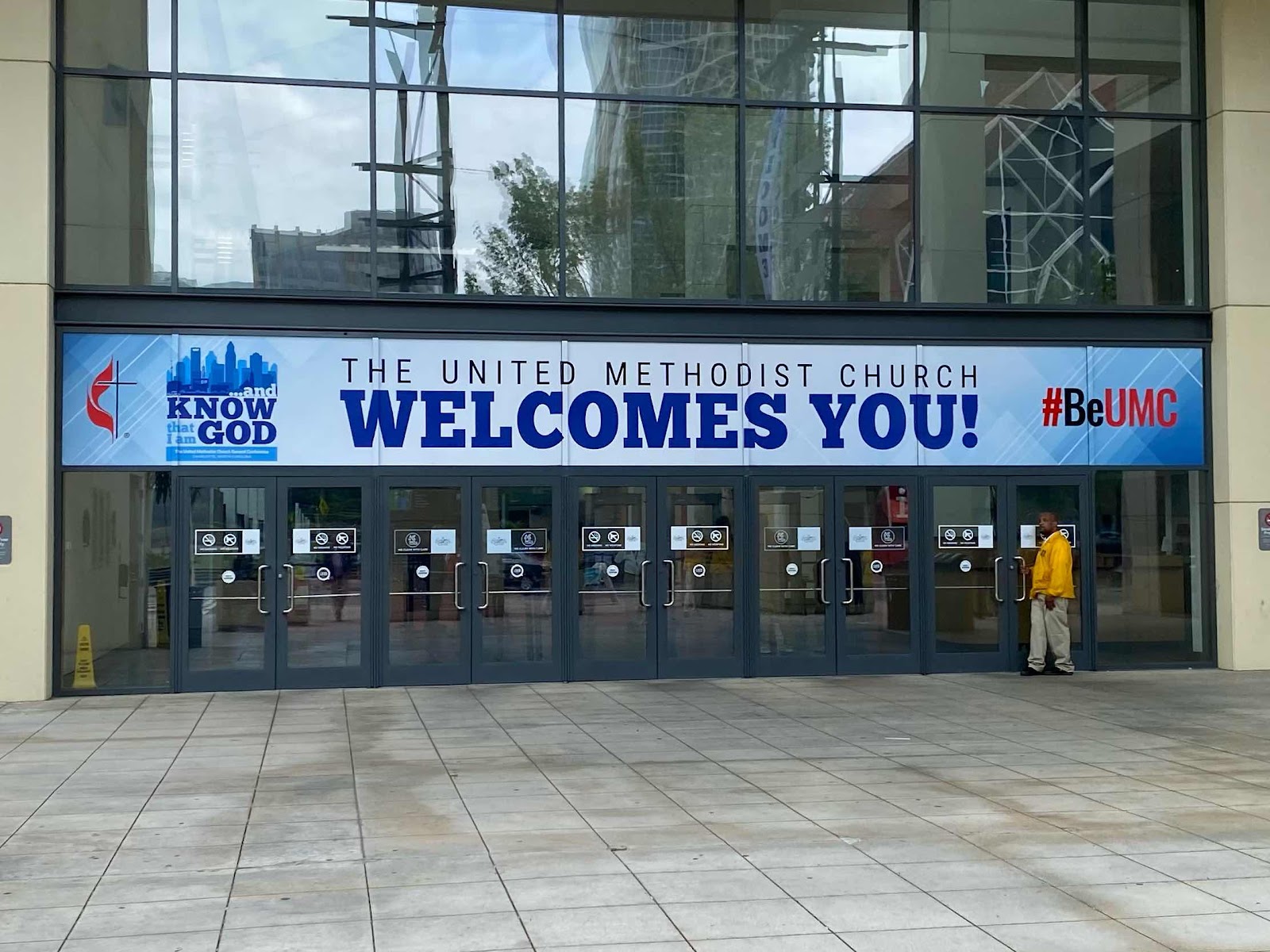
Showing posts with label church history. Show all posts

Wednesday, May 14, 2025

What United Methodists Believe


The local church I’m departing from next month will be revamping its website soon after I start my new adventure as a chaplain in Birmingham. I thought I’d capture the article I wrote for the church's website on basic Methodist beliefs and post it here. I’ve worked on this wording for years, and I’d love to share it with you!

What Do United Methodists Believe?

The United Methodist Church is a 10 million member world-wide denomination, the largest of many denominations in the Methodist faith family that total approximately 80 million people in the world. The United Methodist Church is the second largest protestant denomination in the United States, and the most evenly wide spread. We love our denomination, but we live for Jesus Christ. We follow the passionate, heart-warming spirituality of the English reformers John and Charles Wesley.

We do not believe that we are “right” and everyone else is “wrong.” But we have a unique flavor. Methodists believe that while we are sinners in need of grace, our most essential identity is that we are beautifully created in the image of God. We trust in the expansive nature of God’s grace, which reaches to us before we even know it and continues to transform us long after we embrace it. We believe that God gives us the free will to respond, and we cooperate with God through spiritual practices such as scripture, prayer, worship and sacraments, sacrificing for God, and developing Christian relationships to hold us accountable. These are the “methods” of Methodism, the ways we open ourselves to God’s incredible grace.

Jesus calls us to be followers, not just fans, and personal relationship with Christ nourishes us for that great adventure. We believe in the essential nature of God as Trinity (Father, Son, and Holy Spirit). We affirm that the scripture is the inspired revelation of God, and we believe that Jesus Christ is the Word made flesh to dwell among us. We assume that faith is informed by a healthy balance of scripture, tradition, reason, and experience. We believe that faith in Christ warms the heart and changes the world around us.

There is an excellent website on United Methodist beliefs which includes sections on basics of faith, sacraments, and spiritual living. Check out What We Believe.

Interested in more?

Here are some thoughts and reflections for those who would like to know more about Methodist beliefs.

The Christian church is like a river, with Jesus Christ as its source. In time the river has divided into smaller rivers and tributaries. But like a river, as travelers move upstream, they will find their way back to the source, Jesus Christ.

Traditionally, Wesleyan Christians have emphasized the following:

  • - God reaches us with immeasurable grace. Grace is active in our lives long before we respond, transforms us in faith, and makes us more complete through a lifelong journey. Wesley called these ways of grace prevenient grace, justifying grace, and sanctifying grace.

  • - God gave us the gift of free will. We are called to respond to the graceful initiative of God in our lives.

  • - God will comfort, guide, and forgive every person, no matter who they are or what they’ve done.

  • - Our faith is one of the head, the heart, and the hands. We are called to serve.

  • - We find spiritual fulfillment in the balance of solitary moments of reflection and the activities of a community of faith.

  • - Faith is about love, not about being “right.” In essentials, we have unity. In non-essentials, we value diversity. In all things, we are called to be people of self-giving love.

  • - We are a global movement that’s making a difference in the world. The Church is bigger than we are. We are part of the Body of Christ.

In practice, we are similar to other Protestant denominations, affirming our beliefs through the sacred acts of baptism and communion. For us, these are sacraments, the outward and visible signs of inward and spiritual grace. They aren’t just object lessons. Something happens here.

Through baptism, we accept God’s gift of grace. People of any age may be baptized, including infants who receive the prevenient grace of God. We recognize the baptisms of any Christian faith tradition, and we do not rebaptize those who come into the Methodist faith. There is no requirement among United Methodists about how baptism must be performed, although sprinkling is most common.

Everyone is accepted at the communion table, whether members of the Church or not, whether children or adults. This table is a table of grace and all are welcome. Communion is both a sacred experience with God and a celebration of our community life together. We are always becoming the Body of Christ in the mystery of God’s grace.

The history of United Methodism can be traced back to John Wesley, an Anglican priest who felt his own heart “strangely warmed” with an assurance of God’s love nearly three centuries ago. After this experience, he began a movement of “religion of the heart” along with his brother Charles, a musician and pastor in his own right. The early Methodist movement was based on the expansion of small groups within societies, holding each other gently accountable for their discipleship. It spread like fire through circuit riding preachers on horseback. Their work launched a movement that spread rapidly in the American colonies and took hold with a fervor that still exists almost 300 years later.

During that time, our hearts have led us to build many schools as well as churches. Methodists were among the first to create institutions of learning for settlers, women, and newly freed slaves. There are now 120 United Methodist educational institutions, including schools outside the U.S., most notably Africa University in Zimbabwe. But countless other schools, as large as Auburn University, were Methodist schools at one time.

Today, United Methodists comprise the second largest Protestant denomination in the United States. Our churches are connected by a system to guide our work and govern our policies. We continue to take the lead in social, spiritual, and moral concerns. In the tradition of John and Charles Wesley, our members study scripture, encourage thoughtful debate, and confront the tough issues of the day. We still lead with our hearts, keep our minds open, and welcome everyone through our doors.

Tuesday, April 22, 2025

Announcing Soul Studio on Earth Day


April 22 is “Earth Day,” so as always, the whole world celebrates my birthday.

But this year I turned the big “6.0.” So I’m reflecting on life more than usual.  I’m grateful for your birthday wishes, but what I’m most grateful for is life itself.

I was born on a Tuesday, four weeks (to the day) after the March on Montgomery arrived on the capital steps led by Martin Luther King, Jr. I once went to visit that spot where MLK made his speech, “How Long? Not Long,” exactly 60 years (and 4 weeks) ago. I went just after Obama became president, pondering how far we’ve come in one lifetime. Of course, in some ways we’ve regressed since then, but I am still hopeful.

Soon I will be finishing 36 years of pastoral ministry, having served 8 churches (all of whom grew spiritually and 6 of whom grew numerically while I was there, and 5 of whom are still “United,” I’m happy to say). I’ve done 86 weddings, 168 funerals,  364 baptisms, and exactly 500 professions of faith. I kept record of each and every name.

But I’m not retiring. I’m redirecting my ministry because I really need to be more available to attend to my elderly Dad, help my daughter raise our new grandchild, and care for my wife in this new season. I look forward to the adventure of being a chaplain at Fair Haven and, on the side, launching “Soul Studio,” a ministry of writing, music, and spiritual formation.

The Holy Spirit never quits, I love to say. I am being called to a new adventure, for a new season of life, and for a new period of history.

The best is yet to come.

Wednesday, June 12, 2024

Making My Book Available for Discount


To celebrate a historic General Conference and uplifting Annual Conference, I’ve made my book available for a discount. Amazon and Wipf & Stock have it for $21. I’ll send you a copy for only $15 (with free shipping).


Just EMAIL ME or PRIVATE MESSAGE ME on Facebook with your address! I’ll send it with an invoice and you can pay me later.


If you really want to know why I was active in creating the “Stay UMC” movement, this book is about why.


Adam Ployd, professor and theologian at Wesley House in Cambridge, said, “This book is not so much a work of pure scholarship—though the author has clearly done his homework on the topic of Wesley and communion—as it is an exhortative reflection on the ways in which a robust Wesleyan vision of communion should shape the future of United Methodism. West sees a central problem at the heart of the crisis facing The United Methodist Church: it is being divided by political culture wars that threaten the integrity of the Body of Christ and the radical community it is called to be. The sacrament of Holy Communion, he believes, holds the theological and practical key to renewing the Body and cultivating community in a way that can allow the church to move forward in pious, charitable unity …


“Although West is writing for a popular audience— educated laity and clergy alike—this is an erudite book. West incorporates historical voices, from the earliest generations of Christians to the English Nonjurors and, of course, the Wesleys themselves, in order to educate his reader in some fairly nuanced theological ideas. He does so nimbly, demonstrating both his knowledge of the subject matter and his ability to communicate that knowledge with unusual clarity. Indeed, this is a book to be recommended to all United Methodists struggling with the current crisis who desire a rich, reliable theological resource for thinking about things in a way that transcends the surface-level issues.”


See the link Something Happens Here for more information.

Sunday, May 26, 2024

Wesley wasn’t “converted” at Aldersgate

I have an Episcopalian friend who remarked that it bothered him that people call the Aldersgate experience Wesley’s “conversion”. He’s absolutely right. This is what I wrote in the comments and I want to share it here.

I always balk and correct people when they call the Aldersgate experience Wesley’s “conversion.” You are absolutely on target, that’s reading Wesley through revivalist eyes. That’s saying he wasn’t really a Christian before then, like he wasn’t really “saved.” 

He was in fact quite faithful, studied, and an Anglican missionary in Georgia.

He did not claim that he got “saved” at Aldersgate. His entire theology of the lifelong journey of experiencing prevenient, justifying, and sanctifying grace is in fact what Wesley called “the scripture way of salvation.”

It is far more accurate to say this was a very powerful experience of assurance. “An assurance was given me,” he said, a new peace that he did not have to work so hard. Christian life is about grace. I suppose for some revivalists, this assurance is their definition of “getting saved.” But it wasn’t Wesley’s.

It is important, though, and I would press you back (while completely agreeing about the ridiculous idea that this was his “conversion”) that this experience placed a fire in his belly that became the Methodist movement. It was indeed a turnaround from a perceived sense of failure. He was run off from Georgia, yes, by the family of Sophie Hopky and related legal troubles. But not because he was a general failure as a Christian.

But more fundamentally, it was a vivid personal experience of the “heart religion” he already admired and had seen in the Moravians, and which his brother Charles had experienced the year before.

To use his words, Aldersgate was not an experience of justifying grace (conversion). It was his most vivid experience of sanctifying grace. And that turned his inner light on, with the rest of his life committed to help other people grow in holiness.

Tuesday, May 7, 2024

General Conference Reflections


I sat in as an alternate delegate and voted all morning on the last day on General Conference! It was a joy to participate more actively.

That afternoon, I was driving home from General Conference and reflecting. Just when I thought I might pull over because of a rainstorm to post a few pictures of my last day, I realized I was in Banks County, GA. This reminded me how much I’m UNITED Methodist, with every fiber of my being.

Why? My ancestors started a Methodist society RIGHT HERE in Banks County, GA where they are buried at Mt. Pleasant UMC. Their son (my Dad’s 3rd great grandfather) was ordained by Francis Asbury in 1800. Rev. Levi Garrison was a circuit rider for 7 years until he “located” and pastored local churches in nearby Anderson, SC.

And now here I am in Banks County, posting as the storm clears about how proud I am that the UMC has made it through the storm!

I’ve just left a historic General Conference, where it felt like Annual Conference felt last year. Yes of course there were healthy and normal debates, but all the rancor was gone. There was a sense of companionship, unity, healing, and connectedness.

Here are five huge takeaways for the UMC as we move forward: 

1) “Regionalization” legislation passed with flying colors and will be sent to annual conferences for ratification (it’s a constitutional change). This will give United Methodists in different parts of the world (Africa, the Phillipines, Europe, and the U. S.) a great deal of autonomy in sorting out the social issues of their region, all under one General Discipline with the core beliefs that bind us together. 

2) A fresh new set of social principles were passed which replace the archaic ones that have been amended and strung together countless times. Having a robust set of non-binding social principles (they aren’t church law) has been our tradition for over 100 years, since the church tackled issues such as temperance and child labor and made a big difference. One delegate, who happens to be a Supreme Court Justice in Zimbabwe, practiced true spiritual conferencing to find language to define marriage in a way that Africans, Americans, and everyone else in the room could support in unity. The idea that Africans and the US would never find a way to agree and move forward was a WCA/Good News/IRD “separatist narrative” that we just proved to be untrue. When you were committed to unity, you find a way.

3) The controversial and harmful language in the Discipline about human sexuality has been removed, including the punitive language and schismatic disaffiliation legislation inserted in 2019. We don’t have to agree to be together in unity. So we speak of what we agree on across the diverse world and give each other contextual space to go about the business of the gospel!

4) The denomination practiced good financial stewardship after Covid and the season of disafiliations and reduced budget dramatically. Included in this plan is that no new bishops will be elected this year … anywhere in the five US Jurisdictions … and a number will retire. There will be reassignments and transfers and conferences will creatively share bishops. At the same time, we will add 2 new bishops in Africa (we were originally planning on 5). Our denomination is perfectly sustainable moving forward!

5) As per the original "one church plan" that almost passed in 2019, the punitive bans were lifted, but there were also positive built-in protections for churches and pastors to be as traditional as they want to be. It’s sort of a “federated approach.” It’s always been the best way forward. We are a people of open minds, open hearts, and open doors!

So I am happy to “be UMC” in a new season! Thanks be to God.

Accurate information can be found in our bishop’s letter to the North Alabama Conference. You can find it here:

https://www.umcna.org/postdetail/18354109

More accurate information will be coming out from our annual conference soon. Look for that and talk to your pastor! Naturally, you can’t trust everything you’ll read ot hear, especially when it originates from sources with a separatist or proselytizing agenda.


Monday, March 11, 2024

"Where's the Fire?" Homily Shared at the Academy for Spiritual Formation


This is my homily that was shared at a recent Academy for Spiritual Formation at the Warren Willis camp, a United Methodist retreat center in central Florida. Reflecting on Macarius of Egypt as well as the story of my own grandfather, it's about discovering the fire within us, fueled by the fire of the Holy Spirit.

First Reading: 2 Corinthians 3:12-18 (“And all of us, with unveiled faces, seeing the glory of the Lord as though reflected in a mirror, are being transformed into the same image from one degree of glory to another.”)

Gospel Reading: Mark 9:2-8 (the transfiguration)

—

Sometimes I identify with Peter, not so much when he is doing well but when he is doing poorly. He starts his little speech with “It is good for us to be here,” which is what I catch myself saying when I have no idea how to start. It does say in Mark, “he did not know what to say, for they were terrified.”

So instead, let me start by telling you a story about my mother. She was an amazing person of faith. She was the daughter, sister, niece, wife, mother, and mother-in-law of Methodist pastors (the last one is because I married one). But SHE was the spiritual leader of our family.

I was one of four boys, and one of my early memories is of how she took my brothers to school,  then she sat in a particular rocking chair in the kitchen with her morning coffee for about 45 minutes. She called it her “quiet time.” We were not to bother her during her quiet time! I vividly remember sitting on the couch, listening to her coffee cup click and click on the saucer, wondering when she was going to be finished.

I didn’t know it yet, but she was instilling a longing for God in me.

She was also the kind of person who planned for anything, and that’s where my story comes in. She had a funny habit; when staying at a hotel, the first thing she would do was make sure she knew where fire escape was. Know the type?

One time she and Dad went overseas, and they checked into a hotel. She couldn’t figure out where the fire escape was (there were unfamiliar markings in another language), so she started checking doors. She walked in on a fellow who was in a small restroom. “Oh, I’m sorry, I was just looking for the fire escape.” She quickly closed the door and kept looking.

A minute later, here came that fellow running down the hall, hurriedly pulling his pants up. He was yelling, “Where’s the fire? Where’s the fire?!”

Over the last few years, I’ve been asking myself that same question. Where’s the fire?

After a long Covid shutdown followed by an anti-science blowback, I was left asking, “where’s the fire?” After an uptick of racial tensions followed by extremist insurrection against our capital, and then after a rancor-filled season of division in my denomination, so many things have left me asking “Where’s the fire?”

I didn’t have to ask “where’s the dumpster fire?” We’ve seen plenty of those.

Where’s the fire that burns in the heart, the fire that changes the world?

I had no idea Dwight would teach us about Teilhard de Chardin saying, “Someday … we shall harness for God the energies of love, and then, for a second time in the history of the world, [humanity] will have discovered fire.”

THERE’S the fire. THAT’S the fire my soul longs for.

The word for the day is ENCOUNTERING. I want to introduce you to my friend here. These are icons of Macarius the Egyptian. These particular versions of the Macarius icon look less like Lew than the one I brought here a few years ago … these have more hair! But I chose these particular versions because of a common motif in Macarius icons … his HANDS are held up in the GLOW of God who is all light, all flame, and who illumines the soul.

Macarius was a 4th century monk, one of John Wesley’s favorite spiritual ancestors. We know this because Macarius’ book of fifty sermons were required reading for Wesley’s class leaders, and Wesley himself quoted him in his sermon “The Way of Salvation” when he describes “sanctifying grace.”

I read the sermons of Macarius. It changed my life.

This is partly because I discovered Macarius was the original source of Wesley’s theology of how grace comingles with our free will, and of what BOTH of them called Christian perfection (not flawlessness, but a journey of being perfected by the holiness of love). 

Reading his sermons also changed my life because while Wesley used very exacting language (like “prevenient, justifying, and sanctifying grace”), Macarius used the most wonderful metaphorical language I ever heard, like our SOUL is a ship, or a moving throne, or a chariot with Christ as the charioteer, or a castle (yes, Teresa of Avila picked this up from Macarius and ran with it 12 centuries later).

Do you know what Macarius said about spiritual formation? We are all gathered around a FIRE. I invite you to hold your HANDS UP like Macarius, and hear his words:

“As many lights and burning lamps are lighted from fire, but the lamps and lights are lighted and shine from one nature, so also  Christians are enkindled and shine from one nature, the divine fire, the Son of God, and they have their lamps burning in their hearts.”

Do you know what else he said about that lamp burning in each of our hearts, lit from the one fire? He said our SOUL is like a BRONZE vessel you put burning fuel under so the INSIDES are made warm. He adds, “So also grace, the heavenly fire, is also within you.”

The FIRE of the Holy Spirit burning under us becomes a heavenly fire that burns WITHIN us.

So … “where’s the fire?”

The word of the day is “encountering” and part of us LONGS for that kind of encounter with God - an encounter like Peter, James, and John on the mountain, or like Moses whose face was glowing from a personal encounter with GLOW of the great fire.

Let me tell you a personal story about finding that fire.

After a grueling few years of defending my annual conference from harm (some of you know my journey with the “Stay UMC” movement), one day I got out my Grandpa’s Bible.

I didn’t bring it today (it’s too fragile and priceless) but I keep in on my shelf. If I had time, I would tell you a story of Grandpa Hamby (he led a revival in the 1920’s, and brought pistols to the pulpit to defend the church against bootleggers who were trying to shut it down). It’s a colorful story … after all, I am from Alabama.

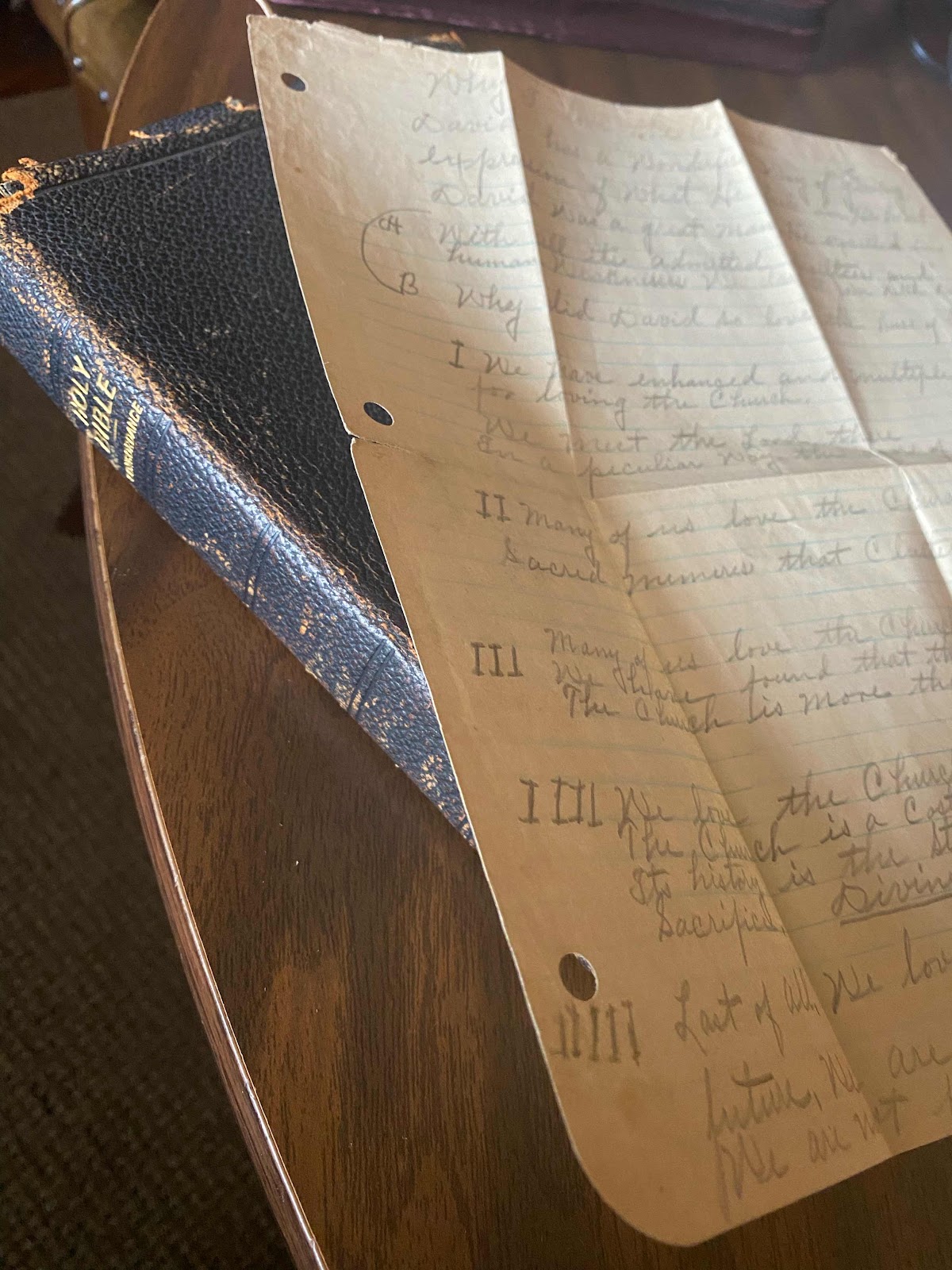
So I have his preaching Bible. (My uncle gave it to me when I was ordained). One day recently I got it out, and something dawned on me after all the pain of the last few years. I realized it was probably the SAME Bible that sat on that pulpit between those two pistols. But I had never gone through his sermon notes that were folded within its pages.

Well, a few weeks ago, I did. I found a particular one … it was entitled “Why I Love the Church.” Grandpa wrote:

“With all its admitted frailties and human weaknesses, we dare to join with David. Why did David so love the house of God? …

He shared a few thoughts, followed by this: “We love the Church because of what it cost.  The Church is a costly institution. Its history is a story of divine and human sacrifice. Divine. Human. (He underlined these two words)

“Last of all, we love the Church because of its future. We are not manning a sinking ship. We are not fighting a losing battle.”

I then had one of those mystical experiences when I wondered if that was the very sermon he was preaching that day with two pistols on his pulpit to protect his church from getting shut down by those bootleggers. Was it his sermon on “why I love the church?” 

What do you know. I would never take guns to church, but maybe it’s part of my spiritual DNA to “stick to my guns.”

What you also need to know is my Granny’s poem is in front of that Bible, written to my uncle on the eve of HIS ordination. I brought a picture so you can see. It’s entitled “Don’t Forget the Glow.”

This poem has always been dear to me, but now it’s taking on new life:


“I stood beside him proudly,

So much he’d learned to know.

And yet I dared to whisper,

‘Son, don’t forget the glow’.”


“The glow that feeds the hunger

In restless human breasts,

The glow that gives the answer

To life’s long, ceaseless quests.


“The glow that’s so rewarding,

When through the preach’d word

They breathe a prayer of ‘thanks, Sir’

For the wondrous things they’ve heard.


“Always put it in your message. 

Hungry hearts, of God’s lost sheep,

Reaching out for strength and courage,

Need soul-food to climb the steep.


“The glow by which your father

Led countless souls to see

The ‘glow-ry’ of the gospel

As it’s surely meant to be.


“A diamond studded highway

Whose end is sure reward.

So keep it bright and shining,

The glory of his Word.”


Are you asking yourself “where’s the fire?” Are you longing for an ENCOUNTER with God?

There’s already a FIRE that burns beneath your “bronze vessel.” It’s the fire of God’s love. Our part is to fuel it with spiritual practices.

We didn’t START the fire. But if we keep the fuel coming, the holy fire grows hot. After simmering a while, we may find that the heat starts coming from within, too. 

And when it does, well, don’t forget the glow.

In the name of the Father, the Son, and the Holy Spirit.


Monday, January 22, 2024

Why Grandpa Hamby loved the Church


Here’s an inspiring word from the preaching Bible that belonged to my Grandpa C. P. Hamby. This is probably the very Bible he laid on the pulpit with two pistols nearby to ward off the bootleggers who were trying to shut down the Church in the 1920’s.

I wonder if this is the very sermon he was preaching. The sermon is entitled “Why I Love the Church.” Grandpa wrote:

“With all its admitted frailties and human weaknesses, we dare to join with David. Why did David so love the house of God? …

“We love the Church because of what it cost.  The Church is a costly institution. Its history is a story of divine and human sacrifice. Divine. Human.

“Last of all, we love the Church because of its future. We are not manning a sinking ship. We are not fighting a losing battle.”

#StayUMC
#BeUMC


Monday, July 3, 2023

Balancing Resources (latest version)


There is plenty of biased and misleading information available on the internet to promote the separatist narrative for leaving the UMC. I offer these balancing resources.

Is the United Methodist Church Really …? – Mythbusting by “Ask the UMC” from United Methodist Communications (parts 1-11 so far)


Bishop Bickerton’s “Mid-State of the UMC” Address

Council of Bishop’s Narrative for the Continuing UMC

Celebrate the UMC Event in Montgomery - Featuring Tom Berlin

Sermon by John Robbins of Pulaski Heights UMC on Staying in the UMC

Adam Hamilton Responds to Maligning and Misleading Videos of Rob Renfroe

Bishops Push Back Against Recruitment Tactics of WCA

African Bishops Condemn the WCA and refuse to go into the GMC

What We Believe – The United Methodist Church

United Methodist Social Principles

“Should I Stay or Should I Go” series by United Methodist Communications

Stay UMC - Grassroots coalition of North Alabama United Methodists

“Why I’m Not Leaving the United Methodist Church” -Letter by Steve West that went viral after first Clear Branch event promoting leaving the UMC

“Open Letter to Chris Ritter” - Letter by Steve West that went viral in response to biased sideby-side comparison distributed by the WCA

“We Believe!” - Steve Harper dispels myths about future beliefs

“That We May Be One” – Texas Conference

“Abide” - South Georgia Conference


"Beginning Again" - Guide for Remaining United Methodist 

Tuesday, June 6, 2023

Addressing the Misinformation about our Core Doctrines

I've had several thoughtful and positive comments on my sermon on Trinity Sunday, so I thought I'd share a portion of it here. It's important!

I'm excited about being part of God's church because of who God is and what God is doing in us. No church is perfect. Last time I checked, it's full of people. And no denomination is perfect. All of them are struggling, but the church is the gift that God gave us, a gift of not only witness for God but for the "with-ness" of God.

And as we talk about the Trinity, I think it's important to address some misinformation that you will find out there in the world. Some opponents of the United Methodist Church say that the UMC is going to somehow abandon core doctrines like the authority of the Bible, or the resurrection, or the virgin birth, or the lordship of Christ, or the Trinity. You name it, I've heard it. Nothing could be further from the truth, and I'm going to tell you a couple of reasons why.

First of all, one method of rhetoric is to take outlying examples - something somebody said, somewhere, in a 12.5 million person denomination - and then you exaggerate it, take it out of context, wrap it into a narrative of the infidelity of the whole, and use it as justification for leaving.

It's a method of rhetoric. But it's an untruth, because second, our core doctrines of the United Methodist Church can not be changed. They're part of something called the Articles of Religion. They are in a constitutional section of our Discipline and were written by Wesley's very own hand, as he adapted them from the Church of England. It would take a 3/4 vote of all lay and clergy members of all annual conferences everywhere, throughout the entire world, to change those core constitutional doctrines.

And the very first one reads like this:

Article I — Of Faith in the Holy Trinity There is but one living and true God, everlasting, without body or parts, of infinite power, wisdom, and goodness; the maker and preserver of all things, both visible and invisible. And in unity of this Godhead there are three persons, of one substance, power, and eternity—the Father, the Son, and the Holy Ghost.

You can not be more clear, and that's "A Number One."

Thursday, September 15, 2022

Book Featured in North Alabama Conference communications

I'm honored that my book was featured in communications of the North Alabama Conference of the United Methodist Church this week. You can find the original article original article here. 

It reads:

"Communion has a way of shedding light on both who we really are and who we are called to be. It is an honest meal. We come to the table being real with God through confession, and Christ comes to us in real ways through his presence, hospitality and grace. The Lord’s Supper binds us together in ways beyond words, for it is a sacred act of both receiving the grace of God and being the body of Christ with one another."

These words come from the Prelude of a new book by North Alabama Conference pastor Rev. Dr. Steve West.

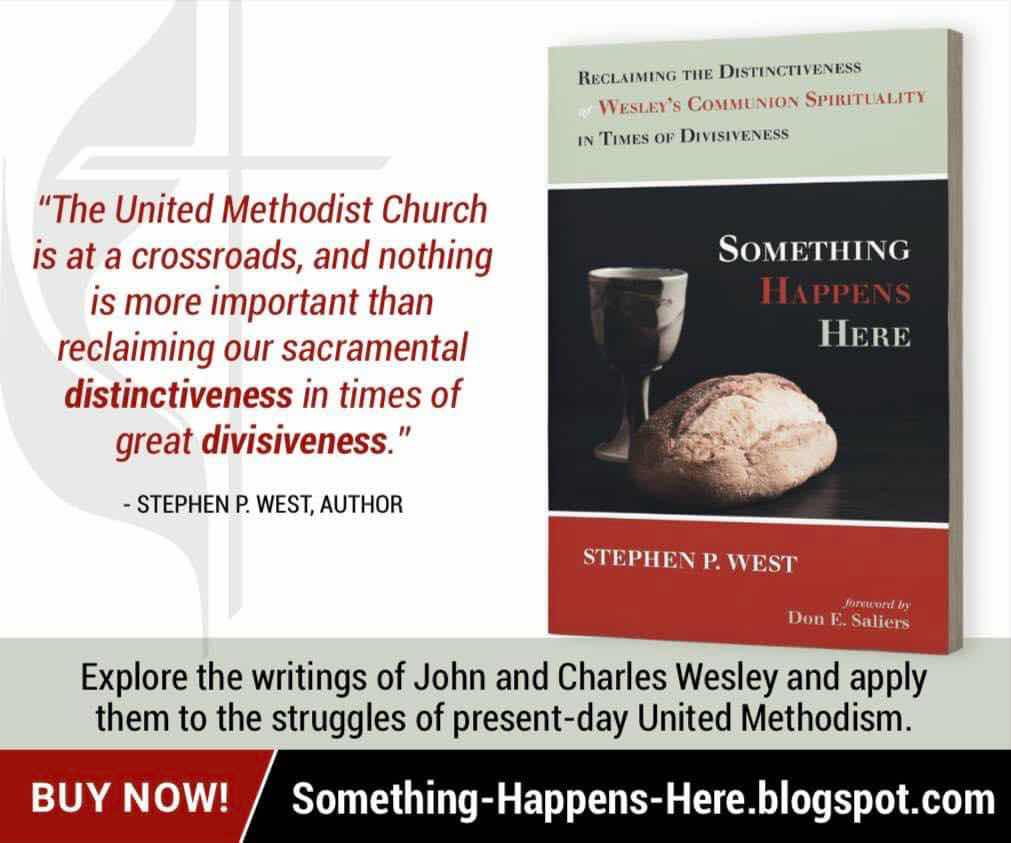
The book titled Something Happens Here: Reclaiming the Distinctiveness of Wesley's Communion Spirituality in Times of Divisiveness has the stated purpose of taking a careful look at John Wesley’s core teaching on the Lord’s Supper. The About this Book introduction explains, “Readers will grapple with the idea that Communion is not just a personal experience with Jesus but a feast that has huge implications for our life together. They will be given language to define themselves against sacramental theology colored by other denominations in their communities. Along the way, they will discover tools to thoughtfully sort through difficult conversations about divisive matters rather than settling into the either-or and ‘us against them’ mentalities that pervade national conversations about culture wars.”

Rev. West, the senior pastor of Jacksonville First UMC (Cheaha District), is descended from multiple generations of Methodist pastors and circuit riders. He has not only a deep belief in the church’s sacramental theology but also a great love of the United Methodist Church. He notes that he wants this book to be a timely resource for United Methodists as the denomination journeys through a season of conflict and division. In that spirit, he says he offers the book as a gift for God’s church and has committed to using 100% of proceeds to go back into promoting the book because he believes “it is so very timely for those who are part of the present journey of the United Methodist Church.”

The book is a scholarly work receiving praise from a variety of United Methodist scholars and authors. Rev. West says, “I hope it will be helpful for the classroom, thought-provoking for church study groups, lifegiving for pastors and church leaders, and accessible for anyone interested in what it means to bind ourselves to Christ and move forward with joy into the future God has in store for us.”

In Something Happens Here West explores the historical background of each core characteristic of Wesley’s communion teachings, finds evidence in the writings of John and Charles Wesley and applies them to the struggles of present-day United Methodism. The unique features of Wesley's communion theology become lenses readers can use as they navigate troubled waters. Chapters include Communion as a Prism, The Mystery of Presence, Experiencing Anew, Become All Flame, Foretaste of Heaven, Grand Channel of Grace, Becoming the Body and Reconnecting. West concludes the book with signs of life emerging as people come back to the Lord's table to move forward into the future.

West writes, “The table is a radical table, because it brings us back to what connects us, which is not agreement or like-minded thinking but community and love-minded thinking. We are bound by our belief, yes, but I’m reminded that in early English, the word 'belief' was pronounced ‘by life.’ How we love those we don’t agree with is the very definition of Christian fellowship.”

The book is available from Amazon or Wipf and Stock Publishers. The book is also available for sale by the author. For a signed copy, see the author or send a check for $22 plus $3 shipping (total $25) to Steve West, 313 2nd Street NE, Jacksonville, AL 36265.

Friday, May 13, 2022

What Would Wesley Say About Leaving the UMC?


“There are those who seem to think they will make the church purer and holier by limiting it to a specific set of legislated opinions.”

ST Kimbrough Jr., renowned Wesley scholar from North Alabama (retired Associate General Secretary for Mission Evangelism for the General Board of Global Ministry), asks what Wesley would say about the splintering minority from the UMC going into the GMC (organizing on May 1) or other offshoot denominations.

What a timely release. Read it at www.stayumc.org.

#stayumc
#BeUMC

Saturday, April 9, 2022

Paul Chilcote on Staying in the UMC


This is from Paul Chilcote, who I’ve had the privilege of serving with on an Academy for Spiritual Formation. He is a retired professor of historical theology and Wesleyan studies.

I am with Paul. I have been saying openly since February of 2020 that I will not be leaving the UMC. He summarizes my feelings well.

5 Reasons to Stay in The United Methodist Church

My roots are deep in The United Methodist Church. Like most “preachers’ kids,” I went through a period in which I questioned my inherited faith tradition, but I came through that process with a deeper appreciation and love for the UMC and all it represents. “Ten Reasons Why I’ll Join the Global Methodist Church," by Jay Therrell, President of the Wesleyan Covenant Association, Florida Chapter, has recently made a new appearance on Facebook. If you read through that document closely, the portrait of the GMC he paints is congregational in polity (not connectional), creedal in orientation (not oriented around “faith working by love”), and essentially exclusive (not inclusive in vision, despite its “global” title). 

I co-chaired the World Methodist Council/Baptist World Alliance Dialogue, and the ten reasons document “feels” like something my Baptist colleagues may have drafted. I do not mean that pejoratively in any way. I love my Baptist brothers and sisters, but the UMC offers a different vision of Christian faith and practice. What concerns me most about this blog is the way in which it diverges sharply, in my humble opinion, from a genuinely Wesleyan vision. 

As May 1 looms large for many of us who are United Methodists, here are my five reasons to stay in the UMC.

1. The UMC has a wide, gracious, and loving embrace. The church I think most people yearn for is a community of faith that puts love at the very center of its life and vision. This openness to all people as unique brothers and sisters deeply loved by God characterizes the UMC I know. All God’s children are invited to put their gifts to use in the service of God’s reign of reconciliation.

2. The UMC aspires to be Christ-like in practice. Countless surveys over the past decades demonstrate that the majority of people in the United States view the church as judgmental. Jesus gives us a different model of relating to the world and others. The UMC seeks to cultivate disciples of Jesus who are like him – merciful, compassionate, forgiving.

3. The UMC is shaped by a dynamic view of scripture. The UMC is strongly biblical in its orientation. The Bible is the bedrock upon which the faith of United Methodists is built. But its view of the Bible is not simplistic; rather, like Wesley, it embraces a dynamic conception of scripture as the “living Word.” Antithetical to literalistic views of scripture, the United Methodist view offers a rich, robust, but yes scriptural foundation for life in the triune God.

4. The UMC is deeply concerned about growth in grace. Not so much invested in believing the right things, its primary passion is translating God’s love into action in life. It elevates the importance of practices of piety, like prayer, but also advocates acts of mercy – compassion and justice for all. The UMC offers a holistic spirituality that refuses to separate the spiritual from the concrete realities of life. 

5. The UMC is missional in character. The UMC does not live for itself, but for others. It is missional in its design to partner with God in God’s great work of love in the world. Its fundamental orientation is outward, spun out in the life of the world to wage peace, work for justice, and to emulate the “beloved community” God desires for all.

Sunday, January 30, 2022

Bishops Speak Out for Staying UMC


Recently, the United Methodist bishops released a thoughtful narrative on what it will look like in the United Methodist Church after the Global Methodist Church splits away and we move forward in history. We have an exciting and hopeful future. We will continue to be a diverse church of traditional, centrist, and progressive Christians, bound together by the love of Christ. We will value healthy diversity about the issues of our day and give people space to practice their faith in different contexts.

It is simply a false narrative that the UMC will be “progressive” and the GMC will be “traditional.” This binary way of thinking is being promoted by those who want to entice others to leave our denomination with them.

You may read the bishop’s narrative of our future yourself here. It speaks to the heart of why I wish to stay in the UMC.

Wednesday, November 10, 2021

What’s Distinctive about Wesley’s Communion Spirituality?


This was my presentation “Taste and See” at Bluff Park UMC this morning. What an honor to be back at one of my “home churches.”

It is on FIVE WORDS that describe what is distinctive about Wesley’s communion spirituality:

1. Presence (sure and real)
2. Remembrance (experience anew)
3. Perfection (in love)
4. Foretaste (of heaven)
5. Becoming (the body)


Sunday, July 18, 2021

An Open Letter to Chris Ritter


Dear Chris,

The United Methodist Church that you and I both love is facing schism. It is a matter of public record that the Wesleyan Covenant Association (WCA), the advocacy group which you help lead as part of their Global Council, has announced that whether or not the Protocol for Reconciliation and Grace through Separation finds support at our next General Conference, the new breakaway denomination called the Global Methodist Church (GMC) will be formed without delay.

I have not had the privilege of meeting you, though you served as keynote speaker in a rally in Birmingham, near my home, held to gain support for the new Methodist movement that will be seceding from the UMC. I wrote a public letter after that event, indicating personal reasons why I am choosing to stay in the UMC. It surprised me as much as anyone that it went viral, and a response to my letter was written and signed by the North Alabama chapter of the WCA and others who organized the rally.

In the spirit of open conversation, I offer this open letter to you, since you recently published a comparison chart that is being distributed by the North Alabama chapter of the WCA, and I presume other chapters as well. It was a well-designed effort in which you contrasted what will be the post-separation United Methodist Church with the newly announced denomination the GMC.

I can see the appeal of such an exercise. Laity need to understand the issues before us, and the issues are complex. There is generalized anxiety in the church. There are many variables, since there is a strong possibility that General Conference will be delayed again due to the coronavirus, and it is possible that the Protocol will not pass, or that one of the other plans coming before General Conference will pass, or that the Protocol will pass but with significant changes, or that all or part of it will be deemed unconstitutional by the Judicial Council. However, no matter what happens, the GMC has announced that it will withdraw and form as a new denomination. As churches prepare for a journey that may eventually lead to local church decision making, a chart makes it simple and easy to understand.

Most of what you indicate on the chart could be considered accurate. However, there are three major blind spots which force me to deem it a well-designed promotional piece, intended to persuade people to leave our denomination, instead of providing a balanced and complete picture.

First, the sections describing the beliefs of the post-separation UMC on abortion and pluralism are pure conjecture and have nothing to do with the Protocol. Of course, the UMC will continue to have a General Conference every four years. But no changes in teaching on these issues are indicated in any of the Protocol legislation. Speculating about these “hot button” culture war issues muddies the waters, alarms and confuses laity, and makes the chart a biased effort with partial truth, at best.

Second, it is conspicuous that the chart does not address contrasting information that is less of a “selling point” for people you are hoping will join you in the new denomination. For example, there is a section on “congregational fidelity” in the GMC’s Transitional Book of Doctrines and Discipline by which a local church can be summarily dismissed from the new denomination if their beliefs or practices are deemed unacceptable in some way by governing bodies beyond the local church (this has no parallel in the United Methodist Discipline). There is a subtle but important change in how the doctrine of grace is presented in the new Transitional Discipline compared to the standard, traditional UMC teaching. There is an intentional change in language about laity trials, compared to the same section in the UMC Discipline, that implies laity could be put on trial for their sexual orientation. There is a self-appointed governing body called the Transitional Leadership Council which has an overwhelming amount of influence over the affairs of the church and broad powers it can later bestow on “its successor.” We have no such thing in the UMC. I could go on.

Third, the very nature of your chart implies that this is a binary choice between two destinies, and this is simply a false narrative. The Protocol does not split the denomination into two parts. Rather, if it even passes, it will allow for the gracious withdrawal of more than one denomination, at least one “traditionalist” denomination and one “progressive” denomination, from the main body of the UMC with millions in start-up funding. The post-separation UMC would remain the largest Methodist body in the United States and remain diverse in thought with traditional, centrist, and progressive pastors, laity, and churches. The Protocol does indicate that the post-separation UMC will remove controversial language in the Discipline regarding human sexuality. However, this action does not “redefine marriage” or force pastors, local churches, or annual conferences to make any decisions or follow any practices they aren’t comfortable with. Rather, it is choosing to allow for diverse and contextualized ministry across the country. In contrasting your two projected denominations on the subject of ordination, for example, you use a simple “yes” or “no.” This does not reflect any nuance of what the post-separation UMC might negotiate to contextualize ministry in the future, according to the Protocol itself.

I am not condemning your attempt to provide a chart. I am appealing to the laity of the church to read your chart with discernment. Some may find it helpful, but it is clearly intended to persuade and it does not give an accurate and balanced picture. I have attached a list of more primary sources from a variety of perspectives that should be read in concert with each other. This will give laity a better picture of the whole.

May God bless your new movement so that together, we can reach different people for Christ in the ever-expanding streams of American religious tradition.

Warmly,

Rev. Dr. Steve West
Member of the North Alabama Conference of the UMC

---

Resources for Study and Discernment

Factual Resources
Video Overview by Tom Berlin

Primary Resources intended to Persuade
Traditionalist Resources:
The Wesleyan Covenant Association
The Global Methodist Church
Centrist Resources:
Uniting Methodists
UMCNext
Progressive Resources:
Reconciling Ministries Network
The Liberation Methodist Connexion

For readers that are part of my home conference, the North Alabama Conference, there are two grassroots resources intended to persuade that should be read and compared:
New Methodist Movement (traditionalist)
Stay UMC (centrist)

Friday, July 16, 2021

A Meditation on Sauty Falls


“A Meditation on Sauty Falls”

by Steve West


The water keeps coming.

It keeps coming, coming, coming.


Across the span of history in a way that’s timeless ... from my limited perspective, anyway ... it keeps coming.


Sometimes it’s bigger, louder, and faster. Sometimes it’s smaller, quieter, and slower.

But it keeps coming.


It’s not only the seasons that affect the flow. Year by year, there are changes. They are so subtle you can’t see it. But I trust it.


Sometimes a stone or tree falls in, and the water finds a new way to flow. Sometimes it carves out something entirely new as a result. Sometimes it takes a really long time.


Then sometimes it’s own creative tendency to make crevices of natural flow is reason enough to find new paths. Sometimes, part of the water ventures away from the central flow. That’s okay too. It’s just another part of the beauty.


When people like me come along to have a look, or take a picture, it’s stunningly breathtaking. But the flow is always secretly, subtly changing.


The water keeps coming. It never stops. That’s how it blesses the world.


Why? Because it’s living water.


It’s Living Water.


That’s what it means to me to be part of God’s Church.


This is a picture I took during meditation time after hiking to the falls in Buck’s Pocket State Park.

Tuesday, June 22, 2021

Systemic Racism and Collective Responsibility

Here is a recent post written by my cousin, Warren Hamby (the son of my Uncle Warren). It is a tribute to my courageous uncle, especially relevant for these times when there are those that deny the reality of systemic racism and collective responsibility.

A little more than 50 years ago, in Jackson, MS, a member of our church who was active in the Civil Rights Movement was a victim of a house bombing by the Ku Klux Klan. He and his family escaped death only because they had minutes before retired to bed. My dad, his pastor, read a statement from the pulpit the following Sunday. Here is part of his courageous statement.

"What had he (Bob Kochtitzky) done (to provoke this)? He had kept the integrity of Christian witness as a sensitive Christian in a society not yet willing to such a witness. He had taken seriously the convictions that were imparted to him by the teachings of the church school and the witness of the pulpit of this church. He had dared to go beyond the respectable acquiescence of the polite forms of Christianity that so often characterize the poor witness of most of us.

"The truth of this is so profound that it turns the question around so that it becomes, not what he has done, but what have we done to prompt this kind of violence?

"Let us not draw a small circle of guilt, for we are all indicted. The so-called decent and responsible people of our city, state and section are the Sauls at whose feet lie clothes of the whole affair. Upon our consciences the whole matter must rest. Justice, Brandeis once said; 'The greatest menace to freedom is an inert people.'

"Who is to blame? Every pulpit where justice and mercy and goodwill have not been enough proclaimed; every alleged Christian who has thought more of his or her prejudices than of seeking the will of God and the spirit of Jesus Christ in attitude and behavior; every newspaper that has defended indefensible positions and voiced its own prejudices; the responsible elected officials of city and state who have been more concerned with expediency than integrity--here, my friends is the accumulated and collective guilt that is ours."

That pastor was my dad, the Rev. Warren Hamby, Sr. To honor him this Father's Day, I could list his good qualities and tell you how much I admired him, but I think the words I quoted above speak for themselves. And tell you how much I miss him since he has been gone from this life, words fail me. There are no words.

Wednesday, April 7, 2021

Beth Moore Speaks Out


I’m a United Methodist, and I respect the faith of my brothers and sisters of other denominations.

But I agree with Beth Moore. I am glad to be part of a denomination that ordains women who are called by God and equipped by the Spirit, and that supports female leadership at all levels of local church life. In fact, the local church I presently serve has been greatly blessed by female clergy on the ministry staff in the past.

I believe the Bible is can be used to reinforce certain attitudes (against women, minorities, Jews, Catholics, the LGBTQ community, etc.) that go past the Bible’s original intent, instead of interpreting all scripture through the lens of Christ, the divine logos (Word of God).

Paul, in his New Testament writings, was simply pastoral and cautious at times, when in actuality the early church’s full inclusion of women was quite progressive for the times, following what was clearly the way of Jesus. His writings should be read in light of other things he wrote in scripture as well as interpreted through Christ.

You can find Beth Moore’s apology for supporting a theology of male dominance here.

Sunday, January 17, 2021

Jesus Comebacks


I ran across this in a book I’m reading, and it gives me great hope.

“Even when Christian culture is compromised by conformity to the values and powers of this world, we can never shed ourselves of Jesus. He has a good record on comebacks.”

Jim Wallis

Friday, December 25, 2020

"The Hay that Heals" - St. Francis and the First Live Nativity


This is a written version of my second Christmas Eve meditation on December 24, 2020. Because of the pandemic, we met for livestream-only worship in the sanctuary, followed by outdoor communion serving and candlelight circle. I shared this meditation on St. Francis by the manger scene outdoors.

Earlier tonight, we gathered virtually by livestream to ponder the scripture, enjoy the music, and explore the meditations of this holy season. We joined in the Great Thanksgiving at the table of grace. Now we gather outdoors to receive this blessed communion and create a candlelight circle. And we do so around this manger for a reason.

Have you heard the origins of the manger scene? The manger scene was created by St. Francis of Assisi.

Francis, who was born into merchant family in Assisi of modern-day Italy, rejected his family’s wealth and even cast off his expensive garments in a public square. He founded the Franciscans, a movement that is dedicated to works of charity with the poor and marginalized. He was, of course, known as a lover of animals and all God’s creation.

In 1223, St. Francis did something special to kindle devotion on the birth of Christ, God’s concern for the poor and oppressed, and God’s love for the animal kingdom. He created the first live nativity. A generation later, in the year 1291, the first pope that was from the new Franciscan order had a permanent manger scene placed in front of one of Europe’s churches. That began the tradition of carved manger scenes we still enjoy today.

But that very first live nativity scene set up by St. Francis himself was placed near the town square. A real manger was placed there with hay, with Mary and Joseph, a carved baby Jesus doll, an ox, and an ass. Francis invited the villagers to come and gaze on the scene while he preached on the “babe of Bethlehem” (they say he was so overcome with joy, he could not say the name “Jesus”).

One witness said the wooden doll of the baby Jesus appeared to cry tears of joy and “seemed to be awakened from sleep when the blessed Father Francis embraced Him in both arms.”

There was another miracle, too, a miracle that I invite us to get our hearts in touch with during this pandemic. I call it the legend of “hay that heals.” The story is that the hay in the manger, from this very first live nativity, healed sick animals and protected people from disease.

We gather outside tonight in the middle of a world-wide pandemic that has changed our gatherings but will not kill our spirits. And we gather because of the healing power of the one who was laid in a manger.

Our staff prepared a little cluster of hay to give each family tonight. We share it with all of us who have come and gathered safely outdoors for closing communion by candlelight.

I invite your family to ponder your little bundle of hay. I invite you to place it under your tree, or on your mantle, or under your centerpiece on this most unusual Christmas Day. Tell others the story of St. Francis and the first manger scene. Recall the legend of the “hay that heals.”

We share this little gift because our world need healing right now, more than ever. We pray that the healing that pours out from the manger of grace will touch us in every broken place.