Showing posts with label Ethics. Show all posts

Friday, April 4, 2025

Restoring Funding for Birmingham Civil Rights Institute

I wrote my letter in supoort of restoring funding for the Birmingham Civil Rights Institute. I urge you to write yours.


Dear Governor Ivey,

Grace and peace to you.

It is my understanding that your proposed new budget does not include any funding for the Birmingham Civil Rights Institute. I am writing to urge you to reconsider.

The news that it has been completely cut comes on the heels of national efforts to suppress conversations about race and the legacy of the Civil Rights Movement. These conversations are essential to understanding who we are and how far we’ve come. The timing of this could not be more sobering.

As a white man who grew up in the south, I do not find the truth of our past to be threatening. I find it challenging and empowering. We need to keep the truth alive.

The stories that line the walls of the Birmingham
Civil Rights Institute are not abstract. They are Alabama history. They are American history, not a whitewashed version but real history.

I am deeply concerned about what removing this funding represents. It appears to be part of a larger extremist effort to undo decades of bipartisan investment in telling Alabama’s story in full—not just the parts that are comfortable, but also the hard truths of segregation, resistance, and the propensity to overcome.

I believe in protecting civil rights history. I believe the Birmingham Civil Rights Institute matters. I believe truth matters. If we don’t know our history, we’re doomed to repeat it, as they say. But just as importantly, if we don’t know our history, we rob ourselves of the opportunity for gratitude.

Please restore funding for the Birmingham Civil Rights Institute.

Sincerely,

Rev. Dr. Steve West
Senior Pastor, Jacksonville First United Methodist Church
Jacksonville, Alabama

Saturday, March 22, 2025

Cultural Christianity

Richard Rohr calls out “cultural Christianity.” I believe this wholeheartedly. It’s an alternative way.


“If our love of God doesn’t directly influence, and even change, how we engage in the issues of our time, I wonder what good religion is. ‘God talk’ becomes an opaque screen in which we see only reflections of ourselves, rather than any kind of true light. ‘Anyone who says they love God, and hates their brother or sister, is a liar’ (1 John 4:20). None of us wants to be a liar, yet religion’s high goals make failure almost inevitable for all of us (read Paul’s attempts to describe this paradoxical phenomenon in Romans 7:7–25). Our daily question is this: ‘Have I even begun to love’?

“Most Christians tend to echo the cultural prejudices and worldviews of the dominant group in their country, with only a minority revealing any real transformation of attitudes or consciousness. It has been true of slavery and racism, classism and consumerism, and issues of immigration and health care for the poor. From a religion based on a man who was always healing poor people and praising foreigners, it defies any logical analysis!”

Tuesday, March 18, 2025

Welcoming the Stranger

This deeply biblical insight on welcoming the stranger is challenging for us!

“This fundamental regard for the resident alien, and call to solidarity with the ‘outsider,’ came to full realization in the teaching and practice of Jesus of Nazareth.”

Check out the full article below.

Tuesday, April 9, 2024

Dietrich Bonhoeffer on real love and community


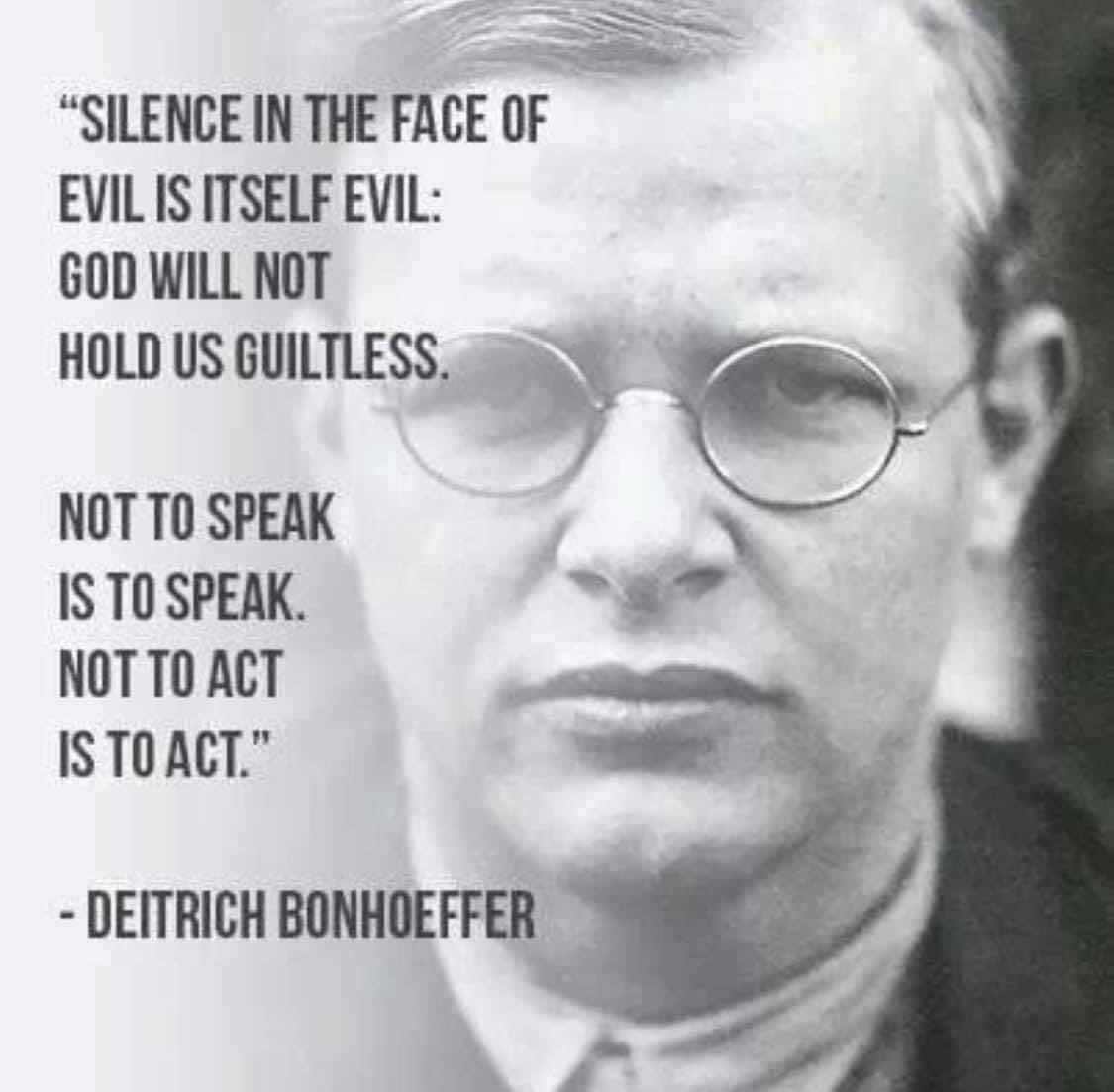
I honor the life of Dietrich Bonhoeffer, who gave his life today (April 9) living the way of Christ in the face of evil.

Two of my favorite quotes are from “Life Together,” and very profound in these times of divisiveness, when those who have led the charge in leaving the UMC were, in my opinion, more interested in their vision of what community should be like than in actually being in genuine community, and more interested in what they thought love ought to be like than in giving themselves to Christ’s love. Lord, have mercy. It breaks my heart.

“Every human wish and dream that is injected into the Christian community is a hindrance to genuine community and must be banished if genuine community is to survive. He who loves his dream of a community more than the Christian community itself becomes a destroyer of the latter, even though his personal intentions may be ever so honest and earnest and sacrificial.”

“What love is, only Christ tells in his Word. Contrary to all my own opinions and convictions, Jesus Christ will tell me what love toward the brethren really is. Therefore, spiritual love is bound solely to the Word of Jesus Christ.”

I still have the book of devotional excerpts my daughter Deborah gave me years ago, and I open it from time to time. It is dear because she gave it to me.

Unlike Shane Claiborne, I’m unwilling to say  his attempt on Hitler’s life was a mistake. Ethics are rather complex when it comes to extreme evil.

Monday, September 5, 2022

Featured in the Sewanee Theolog Gazette


I'm honored that the new book was featured in the Sewanee Theolog Gazette this month. You can find the August 2022 issue here with reference to the book under the section entitled "Notable."

Here is an excerpt from the book that shares an experience I had on campus.

EXCERPT - "Something Happens Here" by Stephen P. West

For four years, I spent three weeks of summer intensives at the beautiful campus of Sewanee: The University of the South in Tennessee, which I affectionately call “Hogwarts on the mountain.” By the third year, I was close to completing the twenty-mile Perimeter Trail around the crest of the mountain. The language of finding a “way forward” had become common in Methodist leadership circles, since we were approaching a called General Conference that was supposed to find some level of resolve over the deepening divide regarding matters of human sexuality. This annual trek was becoming a prayer walk, as I became intentional to pray about the “way forward” as I walked this path. One afternoon after class, I found myself taking a break from my routine hike to check out a natural bridge I had heard about on another part of the campus.

As I walked down the hill to look over this bridge that had developed purely out of divine initiative, I was whisked away into a mystical experience. I climbed to the top of the bridge and crossed over, pondering the concept of finding a “way forward.” Jesus called himself the “way.” He did not say he would show us the way, or tell us about the path, or send us on our journey, but that he is the way. I don’t believe he said this to be exclusive, as it is often interpreted. I believe he said this to remind us that following him is a journey, and the wisdom of God is a path that will take us to new places and new spaces. Christianity is not a list of rules to follow or a set of doctrines to swallow but a relationship with the divine one who is fully embodied in the person of Christ Jesus. We did not need to build a bridge to provide a way forward. It is a gift given to us in Christ. After all, before Christians were called Christians, the movement was simply called “the Way.”

Just as he began his disciples’ journey with the call to “follow me” (Matt 4:19, italics added), he intentionally prepared them for the completion of his earthly life with a meal invitation to “do this in remembrance of me” (Luke 22:19, italics added). As I have said, it is not a call to simply remember a meal, a liturgy, or a lesson on the meaning of the cross but to reexperience me . . . all of me. The invitation at the table completes what could be seen as a two-part calling of the disciples. Life at the table takes us much deeper into the heart of what it means to truly follow. On that natural bridge, I determined that no matter what, wherever this path took me, I would choose the way of Christ. How Christ behaved toward others is the best lens through which we interpret Scripture, even his own words. Christian spirituality is embodied spirituality, and in Christ, the “fullness of deity dwells bodily.”  Jesus offered the invitation at the table when he knew the time was coming soon when he was no longer going to walk on earth. We were to become the hands and feet of Christ.


Wednesday, May 18, 2022

Letter in Support of God's Children

Some of the clergy in the state of Alabama recently signed a letter, expressing love and care for transgender children and their families.

I signed it, too.

I respect differences of opinion on the issues of our day, and I tend to be a centrist on most of them. I lean left on some and right on others. I affirm diversity of thought in politics and am so happy to serve a diverse local church. I stick to preaching the truths of the gospel on Sundays.

However, these laws appear to target marginalized families, and I am passionate about that because it's not the way of Jesus. I signed it not because of politics but because of my passion for pastoral care. It goes too far when the vulnerable are targeted unnecessarily.

You can read about our letter here. A portion of it reads "Seeing love thrive in spite of all the world’s challenges should be a primary goal of God’s followers, as this is what He sent His son to exemplify for us.

"The Holy Spirit moves in profound ways at separate times in each of us and our brothers and sisters in Christ may see some of God’s children through a different spiritual lens. God calls us not to judge our fellow man for difference because of these differing lenses but calls us to help with discernment and to share our knowledge of the love of Jesus Christ. Love one another, be patient for the Holy Spirit to work, and continue to pray for those who harbor fear in their hearts about that which is not easy or comfortable to understand.  Being inclusive of all of God’s children requires bearing a cross for those with lesser voices while attempting to understand their human experiences.

"The life of a Christian requires each of us to think bigger than oneself and to consider the many facets of human existence and the Creator’s unique design of humanity.  The Holy Spirit comforts and strengthens us and reveals our unique talents that equip us to serve the masses and to bring all into the fullest relationship with God possible."

I agree with my friend and former parishioner Judge Liles Burke's ruling. He blocked part of the law he believes is likely unconstitutional, the part which criminalizes offering medical care. You can read about that here. Burke wrote, "Enjoining the Act upholds and reaffirms the 'enduring American tradition' that parents—not the states or federal courts—play the primary role in nurturing and caring for their children." Bingo. That's why I signed the letter.

Burke wrote “Parent Plaintiffs are substantially likely to show that they have a fundamental right to treat their children with transitioning medications subject to medically accepted standards and that the Act infringes on that right" . . . "The Act prevents Parent Plaintiffs from choosing that course of treatment for their children by criminalizing the use of transitioning medications to treat gender dysphoria in minors, even at the independent recommendation of a licensed pediatrician."

I stand by my decision to sign the letter. But if you'd like to grab a cup of coffee and talk about it, I'm all ears. I'd love to hear your perspective.


Saturday, September 11, 2021

On Vaccinations


GET YOUR VAX, PEOPLE!

We are at the ER tonight, where my father-in-law has been stuck in a gurney for hours because there are 90 beds and 140 patients.

- 90% of Covid patients in hospitals are unvaccinated.
- 95% of Covid patients who die here are unvaccinated.
- Soon we will pass 5 million people in the world who have died of this.
- 80 million people in the US are eligible for a free vaccination and refuse to get one.
- The reason we have variants appearing is because everyone is not getting vaccinated quickly.
- There are no microchips being put in your bloodstream, there is no conspiracy to take your rights away, Dr. Fauci is not a liar, and the vaccination is safe.
- If all of us can’t come together on this, it will keep going and going. More people die. This is a fact.
- This is not about personal choice. This is about what it takes to protect humanity.
- This is not about politics. It’s about compassion. Put politics aside.
- It doesn’t matter if you “don’t know what’s in it.” I don’t know what’s in a hot dog and I eat them.
- If we trust God, we should participate in the miracle that the science God created has now created.
- The vax is not just for you. It is for humanity. You’re not just taking your chances. You are endangering other people.
- It’s not about you.

Thanks for listening.

(Of course, there are people with legitimate medical conditions that do not need to take the vaccine. The rest of us should cover for you by getting ours. That’s another way we are all in this together.)

Wednesday, June 30, 2021

Coming to Communion in an “Unworthy Manner”


When I posted the attached picture on Facebook, I got a question from a friend. I succinctly responded to what I think is one of the biggest misinterpretations of Paul’s communion theology today. I thought it would be good to share it here as well.

Here was his question:

And what is your take of the following passage:1 Corinthians 11:29-31 Modern English Version (MEV)29 For he who eats and drinks unworthily, eats and drinks damnation to himself, not discerning the Lord’s body. 30 For this reason many are weak and unhealthy among you, and many die. 31 If we would judge ourselves, we would not be judged.

Here was my response:

That’s  a great question and the scriptural context makes the answer very clear with what Wesley called a “plain reading” of the text. I studied this in my doctoral work.

Paul is not talking about some sense of individual worth or personal morality as many have imagined, but rather he is talking about ethics within the community. The context of 1 Corinthians 11 is that there were divisions in the community (the whole book is about that starting with chapter 1), and in that very chapter 11, Paul was criticizing the way these divisions were made evident even when they gathered at communion (“when you gather, it’s not the Lord’s supper that you eat, for one goes hungry while the other is drunk”). They were not sharing their food and wine, they were not regarding one another with love, they were quite comfortable with the difference in status they had from each other.

What he saw at the communion table becomes a prism through which he looks at the lack of love for each other beneath the surface. He goes on in chapter 12 to teach them how each of them have different gifts, like parts of the body, therefore they should appreciate each other as valuable. Then he says “let me show you an even more excellent way,” and he goes to chapter 13 into the “love chapter” in which he describes what true love is (we like to read this at weddings but what he was addressing was spiritual arrogance and church conflict ... “if I speak in the tongues of people and angels but do not have love, I am nothing but a noisy gong”.) Then in chapter 14, he directly addresses the spiritual arrogance they had against each other. Chapters 11-14 should be read as one block of teaching.

Clearly, when Paul wrote what you quoted he was talking about how they treated each other without love and appreciation and a sense of community. That’s what coming to the table in an unworthy manner is. Not some human line drawn in the sand over what you believe or don’t believe, or what sin is bad enough and what isn’t.

Those who exclude people who earnestly seek God from the table may be the ones guilty of not coming to the table in a worthy manner.

He replied:

I've never heard of any of us Methodist Pastors excluding anyone, have you? 

I responded:

No, the open table is central to Wesleyan theology, you are right.

However, I have heard of Methodist ministers excluding people from membership or attendance or baptism, whether back during the 60’s or in recent days, and that is by proxy excluding them from the table. This is against our Discipline not to mention wrong.

Tuesday, June 22, 2021

Systemic Racism and Collective Responsibility

Here is a recent post written by my cousin, Warren Hamby (the son of my Uncle Warren). It is a tribute to my courageous uncle, especially relevant for these times when there are those that deny the reality of systemic racism and collective responsibility.

A little more than 50 years ago, in Jackson, MS, a member of our church who was active in the Civil Rights Movement was a victim of a house bombing by the Ku Klux Klan. He and his family escaped death only because they had minutes before retired to bed. My dad, his pastor, read a statement from the pulpit the following Sunday. Here is part of his courageous statement.

"What had he (Bob Kochtitzky) done (to provoke this)? He had kept the integrity of Christian witness as a sensitive Christian in a society not yet willing to such a witness. He had taken seriously the convictions that were imparted to him by the teachings of the church school and the witness of the pulpit of this church. He had dared to go beyond the respectable acquiescence of the polite forms of Christianity that so often characterize the poor witness of most of us.

"The truth of this is so profound that it turns the question around so that it becomes, not what he has done, but what have we done to prompt this kind of violence?

"Let us not draw a small circle of guilt, for we are all indicted. The so-called decent and responsible people of our city, state and section are the Sauls at whose feet lie clothes of the whole affair. Upon our consciences the whole matter must rest. Justice, Brandeis once said; 'The greatest menace to freedom is an inert people.'

"Who is to blame? Every pulpit where justice and mercy and goodwill have not been enough proclaimed; every alleged Christian who has thought more of his or her prejudices than of seeking the will of God and the spirit of Jesus Christ in attitude and behavior; every newspaper that has defended indefensible positions and voiced its own prejudices; the responsible elected officials of city and state who have been more concerned with expediency than integrity--here, my friends is the accumulated and collective guilt that is ours."

That pastor was my dad, the Rev. Warren Hamby, Sr. To honor him this Father's Day, I could list his good qualities and tell you how much I admired him, but I think the words I quoted above speak for themselves. And tell you how much I miss him since he has been gone from this life, words fail me. There are no words.

Wednesday, March 24, 2021

Red Letter Christians

Today, I signed the "Red Letter Christians" pledge. I believe this with all my heart and life. You may want to consider signing it as well.

It is time for Christians to stand up for what is right, what is good, what is gospel. We aren't truly living as Christians unless we are on the journey of giving ourselves to the vision of the kingdom of God. If we do it not unto the least of these, we do it not for Christ. Be a part of the kingdom breaking into our world!

For more information, go here. A copy of the pledge is below.


I dedicate my life to Jesus, and commit to live as if Jesus meant the things he said in the “red letters” of Scripture.

I will allow Jesus and his teaching to shape my decisions and priorities.

I denounce belief-only Christianity and refuse to allow my faith to be a ticket into heaven and an excuse to ignore the suffering world around me.

I will seek first the Kingdom of God – on earth as it is in heaven – and live in a way that moves the world towards God’s dream, where the first are last and the last are first, where the poor are blessed and the peacemakers are the children of God, working towards a society where all are treated equally and resources shared equitably.

I recognize that I will fall short in my attempts to follow Jesus, and I trust in God’s grace and the community to catch me when I do.

I know that I cannot do this alone, so I commit to share this journey with others who are walking in the way of Jesus. I will surround myself with people who remind me of Jesus, help me become more like him and hold me accountable for my actions and words.

I will share Jesus with the world, with my words and with my deeds. Like Jesus, I will interrupt injustice, and stand up for the life and dignity of all. I will allow my life to point towards Christ, everywhere I go.

Tuesday, February 23, 2021

John Rutland, George Wallace, Communion, and the Kingdom of God

February is Black History Month, and we have also entered the holy season of Lent. Our United Methodist Bishops have called the church to a Lenten season focused on dismantling racism. Their devotions may be found here.

This convergence has led me to share a story that I recently wrote down for the first time. 

It's part of an introductory chapter in a book I am writing on the distinctiveness of Wesley's communion spirituality in our times of divisiveness.

Attached is a picture of Rev. John Rutland and his wife Mary.

If there is such a thing as a mind-blowing story about Holy Communion, I have one. I heard it years ago from a man named John Rutland. He had been a friend of my family since long before I was born. John was one of the old time Methodist preachers of the North Alabama Conference, always wearing a white shirt, a blazer or sport coat, a super-wide tie, and an even wider love for Jesus. He had a spring in his step and a twinkle in his eye, and to me this short, stocky man was always larger than life.

He and my dad had been colleagues in ministry, and John loved to tell of a time he gave me a quarter when I was a child and he was my father’s District Superintendent. Apparently, I got up in his lap and said “Brother Rutland, when you go to that place …” He said, “you mean Annual Conference?” “Yes, and you see that man …” He responded, “you mean the bishop?“ “Yes, will you tell him to send my daddy to Disney World?”

John had told me plenty of stories, though his communion story brought them all together. My wife and I had become associate pastors at the same church he served in his retirement, and he told me numerous tales from his years of preaching in the middle of Birmingham civil rights history and his uncanny tendency to step into it. He once took me to the pulpit area of the old Woodlawn United Methodist Church and pointed to a seating section on the far right, near the exit. “That’s where Bull Conner used to sit … when he was sitting, that is.” I knew, of course, that “Bull” was the infamous commissioner in Birmingham that oversaw the police and fire departments, enforcing segregation and becoming a national symbol of police brutality with police dogs and fire hoses. Conner had been a member of that church during the Civil Rights era when Rutland pastored there. “Sometimes, when I would preach that Jesus loved all people, regardless of the color of their skin, he would stand up, huff, and storm out.” 

Standing by the pulpit that day, he told me the colorful story of the time he walked up to Conner and his deputies standing on the front steps of the church with their arms crossed. After he asked what they were doing, Conner said, “we’re making sure only the appropriate people come to church today.” John got up in his face and said, “let me tell you something, Mr. Conner. I’ve been appointed by the bishop to be pastor of this church, and I will decide who can come in for worship. And if you get in my way, I’ll call your own police department and have you removed.” He then walked away, his legs feeling like limp noodles. As he turned the corner, he heard Conner whisper to his deputies, “let’s go boys. He’ll do it.” John Rutland must be one of the few people that Bull Conner backed down from. 

On another occasion, John told me of a letter he had once gotten from Alabama Governor George Wallace. He had been with a group of preachers who had met with Wallace a few weeks prior to his first inauguration, a meeting when he had made all sorts of promises to these pastors who were in favor of integrating schools. Then at the inauguration, Wallace made the infamous speech with the words, “segregation now … segregation tomorrow … segregation forever!” John was perplexed and wrote Wallace a letter asking how he could possibly change his tune so dramatically in such a short period of time. Wallace wrote back to him saying, “I’ve been out-segged and I’m not going to be out-segged again … you fancy-pants preachers had better watch your back in Alabama.” 

So, you can imagine how I felt when Rutland walked in my office one day and said, “I wish you’d been here yesterday.” I had been visiting the hospitals, and boy was I sorry. “I dropped by to see if you wanted to go with me to serve communion to George Wallace.” He then told me one of the most compelling stories about Holy Communion I have ever heard. 

Our bishop, Lloyd Knox, had called John Rutland to ask if he had a portable communion set. George Wallace, still a Methodist, had called Bishop Knox from his death bed and asked if he would come serve him communion. The bishop had been busy preparing to move away from the Annual Conference at the end of his term, so his was already packed. “John, I want you to go with me to serve communion.” 

“Um, bishop, I’d be glad to loan you my communion set, but I really don’t think you want me to go visit George Wallace with you.” As John put it, the bishop could be very persuasive, as bishops can be. He went after all, just hoping that since it had been so many years, Wallace would not recognize him. But as soon as he walked in the room, Wallace looked at him and said in a booming voice, “John Rutland!” 

 He sheepishly walked into the room. The bishop gathered them around the hospital bed and asked why he wanted to receive communion. Wallace said, “I asked you to come today because for so many years, I was wrong. I was wrong about a lot of things.” He shared that he needed to make his peace with God. Bishop Knox went and got the nurse out of the hallway, and she happened to be African American. They all shared the holy meal together. 

John finished his story with words I will never forget, “Here we were, Bishop Knox, George Wallace, a black nurse, and the ‘fancy-pants preacher’ sharing communion together. Now that’s the kingdom of God!” It certainly is. 

Communion has a way of shedding light on both who we really are and who we are called to be. It is an honest meal. We come to the table being real with God through confession, and Christ comes to us in real ways though his presence, hospitality, and grace. The Lord’s Supper binds us together in mysterious ways, for it is a sacred act of both receiving the grace of God and being the body of Christ with one another. 

John Rutland’s story has stuck with me during the remainder of my life and ministry. It was not just a tale about race relations. It was a crystallized moment in time that sheds light on the holy meal. We taste and see the goodness of the Lord. We get an honest look at who we are, experience how incredibly beloved we are, and get a glimpse of life in the kingdom of God while we are at it. No, it’s not magic. A better word for it would be mystical.

Copyright 2021 Stephen P. West, all rights reserved

Friday, November 15, 2019

Bound by Love

“As a Christian, when confronted by a tension between a religious certainty which leads me to violate the law of love and a deep unknowing that still moves in the direction of ‘loving my neighbor as myself,’ I am bound to choose the latter course.”

Cynthia Bourgeault 

Wednesday, August 7, 2019

Tortured by Their Own Hunger


“For what is evil but good tortured by its own hunger and thirst?” - Kahlil Gibran

This is an extremely wise saying. The farther I get in life, the more I see it. There’s a reason Jesus said, “Love your enemies and pray for those who persecute you.”

It helps us see that those who oppose us in life are coming from a place of brokenness we can’t understand. It’s freeing to be clear with ourselves about who we are, and give the rest to God.

Wednesday, October 17, 2018

Why Fight About Prayer When We Can Pray About Fighting?

This is my column that was published in The Arab Tribune on Wednesday, October 17, 2018.

My mother had a habit that I thought was very odd as a child. She had a particular rocking chair, armless and covered in striped velvety fabric. She kept it in the kitchen of whatever house we lived in, near the coffee pot. That was where she had her morning quiet time.

We knew good and well that we were not supposed to disturb her. I learned it was a bad time to ask her for something, because the answer would probably be no.

The younger I was, the more that 45 minutes she spent in her chair, unavailable for me, was like an eternity. I vividly remember lying on the couch, listening to the repeated click of her coffee cup against the saucer, wondering when she’d be through.

Though Mom died years ago, she continues to teach me. She had a contemplative spirit that I inherited, but it didn’t unfold until I was well into adulthood. For her, this morning time spent with God was holy and precious, not forced. And the rhythm of her quiet time, near the opening of each day, was life-giving to her. It was the hook she hung her life on.

I am beginning to see that her faithful witness (and healthy boundaries with her kids) made an impact on my life. She taught me about prayer, not just by what she said but by what she did. It’s a bigger lesson than “now I lay me down to sleep, I pray, the Lord, my soul to keep.”

I watched her make time with God a priority.

In my adult life prayer has become my heart’s longing. Prayer is nothing more, and nothing less, than spending quiet time with God. It’s not complicated. It’s just time. It is healing for the soul.

Quiet reflection, offered to the Lord as a simple gift, is worth it for its own sake. We have to see past our functional assumptions about what prayer “does.” Early In the journey, we learn that it’s about intercession (praying for others) or petition (requesting things of God). We say prayer “works.” That is indeed powerful praying. But this is only a piece of the prayer pie.

Prayer is praise, gratitude, adoration, and contemplation. Prayer is confession, conviction, and honest sharing with God, who sees all and loves all the more. Prayer is silence as much as it is talking, and the purpose is most definitely not limited to giving information with God that God already knows.

I’m no expert and I don’t feel called to live in a monastery. But I do know that it’s easy to oversimplify prayer to asking God for things. Yet it’s also easy to over analyze prayer. Some even think you have to “cover all the bases,” as if prayer is about getting everything in (oh dear, I forgot about adoration today!).

It has been life-giving to get beyond seeing prayer in terms of what it does, and experience it as an outflowing of love for the one who created a deep desire in me. I love morning prayer, evening prayer, contemplative prayer, walking prayer, silent prayer, spoken prayer with friends ... all kinds of spending time with God. My heart burns for it and my soul yearns for it.

So I must admit, even though I’m a religious leader and a believer in prayer, it troubles me to see people fighting about prayer before ball games. For me, at least, that reduces prayer from what it is, an amazing gift and an invitation to share in the heart of God, to something God did not ever intend it to be ... a cultural symbol like flags and statues.

I am so glad to live in a country where we are free to pray. I pray at ballgames and grocery stores, parks and community events. I pray in the car or on the phone. There is no limit to how or where I can pray.

It does not threaten my faith to acknowledge those of other faiths, or no faith at all, and be content with a moment of silence to pray for safety and good sportsmanship. In fact, I think it’s bad sportsmanship to assume that the only prayer that counts is the kind that takes place over a loudspeaker.

Moments of silence don’t bother me because silence is the best prayer anyway. It is said that silence is God’s first language. So I take my hat off and I gladly pray. I suppose I don’t get upset about the lack of a microphone because I am incredibly grateful. In our country, we are free to pray all we want.

Here’s an idea for all of us. Why not pray for those we disagree with? Why fight about prayer when we can pray about fighting? And if you feel led to hold a prayer circle over in a corner at the game, I’d love to come.

I have seen the decision about prayer at football games compared with interrupting Jesus when he prayed on the hillside before feeding the 5,000.For me, that’s apples and oranges. Jesus didn’t insist on taking the microphone before athletic events at the Roman stadiums.

He drew people to the hillside. He taught them and fed them and prayed for them. He was not making a statement, he was abiding with his Father ... and welcoming those who wanted in on their conversation.

Maybe we need more prayer on the hillside and prayer at the gameside. Fighting about prayer is making prayer something other than the gift it was meant to be. Why reduce it to a cultural symbol, when it’s so much more?

As Richard Foster put it, prayer is the heart’s true home. Jesus said to love our enemies and pray for those who persecute us. He didn’t say to fight against those who persecute us.

Whether you feel public prayer persecutes those of other faiths, or lack of public prayer persecutes those of Christian faith, it’s fair criticism either way. But the prescription is prayer itself.

Prayer is the gift God gave us to deal with the struggles of life. As I write this, I am planning to go to the hillside, or the lakeside at least, tomorrow. I plan to walk and pray, and to let go of my troubles and be filled with the quiet presence of God. I hope to be renewed and refreshed. I invite you to go with me, in your own way.

Steve West is a husband, father, minister, musician, and writer who pastors Arab First United Methodist Church. His blog, “Musings of a Musical Preacher,” is found atwww.stevewestsmusings.blogspot.com.

Saturday, March 17, 2018

The Astonishing Red-Letters of Jesus

This is my column that appeared in The Arab Tribune on Wednesday, March 14, 2018. I found it humorous that the editor entitled the piece "Jesus' red-letter words show he was progressive," since I am, hopefully, claiming a set of Christian ethics that defies political labeling.

Somebody came in my study a few days ago and said, “wow, you have a lot of books. Have you read all of them?”

Why ask a pastor a question like that? Of course I haven’t.

In fact, I pulled one off my shelf and placed on my desk a few months ago … and it has sat right there ever since. It’s on standby. It’s called “Primal” by Mark Batterson, and I suppose I’ll get to it when the time is right.

But the back of the book inspires me. I read it every once in a while.

It says, “What would your Christianity look like if it was stripped down to the simplest, rawest, purest faith possible? You would have more, not less. You would have the beginning of a new reformation—in your generation, your church, your own soul. You would have primal Christianity.”

The book cover continues, “This book is an invitation to become part of a reformation movement. It is an invitation to rediscover the compassion, wonder, curiosity, and energy that turned the world upside down two thousand years ago. It is an invitation to be astonished again.”

Do you long to be astonished again?

If so, I have a suggestion. It sounds simple, and it is ... the simplicity is precisely why we don’t do it. It’s coming back to what Jesus actually said.

Christians focus so much on having Jesus “in my heart,” and holding a ticket to heaven, that we forget being a follower is about our whole life. Following Jesus is about our jobs, our marriages, our families, our neighborhoods, our finances, our health, our priorities, and our politics.

So if you want to be astonished again, go back to the "red letters" of Jesus. You find them in those Red Letter Bibles that highlight the words Jesus actually said.

Honestly I’ve always had mixed feelings about Red Letter Bibles. His words aren’t more “scriptural” than other scripture. But the farther along I get in my faith, the more I see that if I’m really going to live it, those red letters are more fundamental than fundamentalism.

The words of Jesus have profound impact when lifted out. Like raw sugar, it shows us the raw Jesus, pure and unvarnished.

What you discover may surprise you. Jesus did not talk at all about things we tend to make religion about in politics, when we reduce it to a couple of controversial moral issues. But on the other hand he lived an incredibly political life.

He was amazing in his progressive treatment of women. He confronted the racism of his people against Gentiles and Samaritans. He had a heart for the outcast. He lifted up mission with the poor and impoverished. He taught radical peacemaking, saying “those that live by the sword die by the sword.”

He said that it is what comes out of our mouth, not what goes in, that defiles. He spoke of those who are without sin casting the first stone, calling out judgmentalism for what it is. He affirmed those who are poor, meek, mourning, and weak.

He called people to a whole new world of grace, the kingdom of God, which has embedded in it a vision for justice for all people. He said strange things like “the last shall he first and the first shall be last.” He stood squarely against the accumulation of wealth.

These are the “Red Letter” issues.

Are you a “Red Letter Christian?” Or are you content with human, divisive labels like liberal and conservative?

I accept neither label because I’d rather just follow the gospel. It’s time that we disentangle divisive political labels from our faith and let the gospel be our guide.

Mark Lowry is a self-proclaimed "recovering fundamentalist." He sang with the Gaither Vocal Band, then took year off and decided to read the "red letters.”

I heard him speak once, when he said, “Have you ever read the red part of the Bible? It will mess you up!"

He continued, "You know what I found out? We've been hanging around the wrong people. We've got to start hanging around some more prostitutes! Jesus hung out with the outcast. Jesus hung out with the freaks and failures and vagabonds. The only people Jesus chewed out were the religious folks."

Lowry admitted "I didn't make a good fundamentalist because I could never figure out, how do you love the sinner but hate the sin? There's so many of you! I don't have time to hate your sin ... hate your own sin! Hating my own sin is a full time job! The psalmist said 'my sin is ever before me.' I say this ... love the sinner, but hate your own sin! You hate your sin, I'll hate my sin, and let's love each other!"

Now that’s a “Red Letter Christian” if I’ve ever heard one.

Steve West is a husband, father, minister, musician, and writer who pastors Arab First United Methodist Church. His blog, “Musings of a Musical Preacher,” is at www.stevewestsmusings.blogspot.com.

Thursday, May 14, 2015

Bishops Write Pastoral Letter on Racism


When I saw this beautifully written pastoral letter from the bishops of the UMC, I immediately felt led to share it with all of you. In light of
 recent rioting on American soil, I am reminded of the historic struggles of the American soul. Let us all pray for healing for all of God's creation.

The Council of Bishops issued a pastoral letter on racism to the people of The United Methodist Church affirming the sacredness of all lives and renewing their commitment to work for an anti-racist, pro-humanity church. The action came at the end of the Council’s weeklong meeting in Berlin in May of 2015.

The letter reads:

Grace and peace in the name of Jesus Christ!

We, the bishops of The United Methodist Church, are meeting in Berlin, Germany, 70 years after the end of World War II.  As we gather, we renew our commitment to lead, as together we seek to become the beloved community of Christ.  

We are a church that proclaims the Gospel of Jesus Christ to the world.  On every continent, people called United Methodist are boldly living the mission of making disciples of Jesus Christ for the transformation of the world.  Yet, the people of our world are hurting, as injustice, violence and racism abound.  Our witness to the dignity of all human life and the reign of God is needed now more than ever.

Our hearts break and our spirits cry out, as we see reports of migrant people being attacked and burned in the streets of South Africa, note the flight of Jews from Europe, watch the plight of Mediterranean refugees and see racially charged protests and riots in cities across the United States that remind us that systems are broken and racism continues.  The evidence is overwhelming that race still matters, that racism is woven into institutional life and is problematic to communal health.  This reality impacts every area of life – in the church and in the world.

Racism is prejudice plus intent to do harm or discriminate based on a belief that one is superior or has freedom to use power over another based on race. Xenophobia is an unreasonable fear or hatred of foreigners or strangers or of that which is foreign or strange.  Racism and xenophobia, like other sins, keep us from being whole persons capable of living up to our full potential. They deny the profound theological truth that we are made in the image of God with the handprint of love and equality divinely implanted in every soul.

As bishops of the Church, we cast a vision for a world community where human worth and dignity defeat acts of xenophobia and racism. We acknowledge that silence in the face of systemic racism and community fears serves only to make matters worse.

We commit to lead, model and engage in honest dialogue and respectful conversation and invite people of faith everywhere to join us.  Let us repent of our own racial bias and abuse of privilege.  May we love God more deeply and, through that love, build relationships that honor the desire of people everywhere to be seen, valued, heard and safe. As we proclaim and live the Gospel of Jesus Christ, may we lead the way in seeking justice for all, investing in and trusting God’s transforming power to create a world without hatred and racism. 

As United Methodists, we affirm that all lives are sacred and that a world free of racism and xenophobia is not only conceivable, but worthy of our pursuit.  We renew our commitment to work for a Church that is anti-racist and pro-humanity, believing that beloved community cannot be achieved by ignoring cultural, racial and ethnic differences, but by celebrating diversity and valuing all people.

“This commandment we have from him: Those who claim to love God ought to love their brother and sister also.” 1 John 4:21 (CEB)