The theme of opening worship moments was “Silence” on the Saturday morning of Annual Conference, May 31, 2025. I enjoyed blending three “songs of silence.”
Showing posts with label Liturgy and Worship. Show all posts
Showing posts with label Liturgy and Worship. Show all posts
Thursday, June 5, 2025
Let All Mortal Flesh/Sound of Silence/You Are Mine “Mashup”
I enjoy leading singing at Annual Conference and using my creative juices in the planning and selection of songs.

Tuesday, May 27, 2025
Walking Prayer for North Alabama Conference of the UMC

With a little help from Chat GPT, I created this "walking prayer" liturgy for gathering leadership the day before Annual Conference. We will pray on Wednesday, May 28, at 3:00 pm. Join us in the spirit of prayer, even if you are not physically present.
GATHERING
Leader: Let us begin in the name of the Father, and
of the Son, and of the Holy Spirit. Amen.
All: Come, Holy Spirit. Fill this place. Prepare
every room to be a space of grace.
Song: “Spirit of the living God”
Scripture: “How lovely is your dwelling place, O Lord
of hosts! My soul longs, indeed it faints, for the courts of the Lord.”—Psalm
84:1–2a
Prayer: Gracious God, we
dedicate this space and the time we spend here to You. As we walk
and pray, let our steps be guided by your Spirit. Prepare each area
to be a sanctuary of your presence. Open hearts, renew minds, and
ignite faith in all who will gather here. In Jesus’ name, Amen.
WALK TO THE MAIN
ENTRANCE
Scripture: “Welcome one another, therefore, just as
Christ has welcomed you, for the glory of God.” —Romans 15:7
Prayer: God of welcome,
may all who enter this place feel received, known, and safe.
Let the hospitality shown here
reflect your gracious invitation to all.
Prepare hearts from the moment
they step through the door. In Jesus’ name, Amen.
WALK TO THE LABYRINTH
Scripture: "Stand at the crossroads, and look,
and ask for the ancient paths, where the good way lies; and walk in it, and
find rest for your souls." — Jeremiah 6:16
Prayer: God of the journey, In this winding path,
remind us that every step with You is holy. Still our anxious thoughts, open
our hearts, and lead us in the way that brings peace. Let this walk draw us
nearer to Your presence. In Jesus’ name, Amen.
WALK TO THE MISSION
DISPLAYS
Scripture: "The Spirit of the Lord is upon me, because he has anointed me to bring good news to the poor. He has sent me to proclaim release to the captives and recovery of sight to the blind, to let the oppressed go free, to proclaim the year of the Lord’s favor."— Luke 4:18–19
Prayer: God of mercy and
mission, You call us beyond our walls and beyond ourselves. As we give witness
to stories of service and justice, ignite in us a holy urgency to love boldly,
give freely, and serve faithfully. Let our hands become Your hands. Amen.
WALK TO THE
PRAYER ROOM
Scripture: “In returning and rest you shall be saved;
in quietness and in trust shall be your strength.” —Isaiah 30:15
Prayer: Prince of Peace, may this room be a refuge
for the weary and a wellspring for the seeking. Let burdens be lifted and
hearts be still. Meet each person here in sacred silence and prayer. In Jesus’
name, Amen.
WALK TO THE
DINING AREA
Scripture: “They broke bread… and ate together with
glad and sincere hearts.” —Acts 2:46
Prayer: Lord of abundance, bless this space where
people will share meals and stories. Let every table become a table of
connection, joy, and spiritual nourishment. Feed us in body and soul. In Jesus’
name, Amen.
WALK TO THE SANCTUARY
Scripture: “Where two or three are gathered in my
name, I am there among them.” —Matthew 18:20
Prayer: Holy God, let this be a
place of Spirit-filled worship and conferencing.
Open every ear to hear your voice, every heart to receive your Word. Pour out your power through music, preaching, prayer, deliberation, celebration, and silence.
Song: “Surely the Presence”
CONCLUSION IN
THE NARTHEX
Leader: We have walked these rooms and halls with
prayerful hearts. We now entrust this space, this Annual Conference, and all
who will come here to the work of the Holy Spirit.
Prayer: God of the journey, bless every step taken
in this place. As people move between sessions and rooms, may they carry
your peace. Let even the in-between moments be filled with your
presence. Use this entire place for your glory. Let lives be
changed, souls refreshed, and faith renewed. Make this house a holy ground, a
meeting place between heaven and earth.
Leader: May the God who walks before us, beside us,
and within us bless every gathering, every word spoken, every heart that draws
near. Go now in peace. Amen.
Monday, December 23, 2024
Birmingham-Southern College Carol Service
Though my Alma mater closed this past May, we are keeping the annual Carol service tradition alive. It was my joy and privilege to sing in it in December of 2024.
I invite you to have a listen.
Wednesday, June 12, 2024
Making My Book Available for Discount
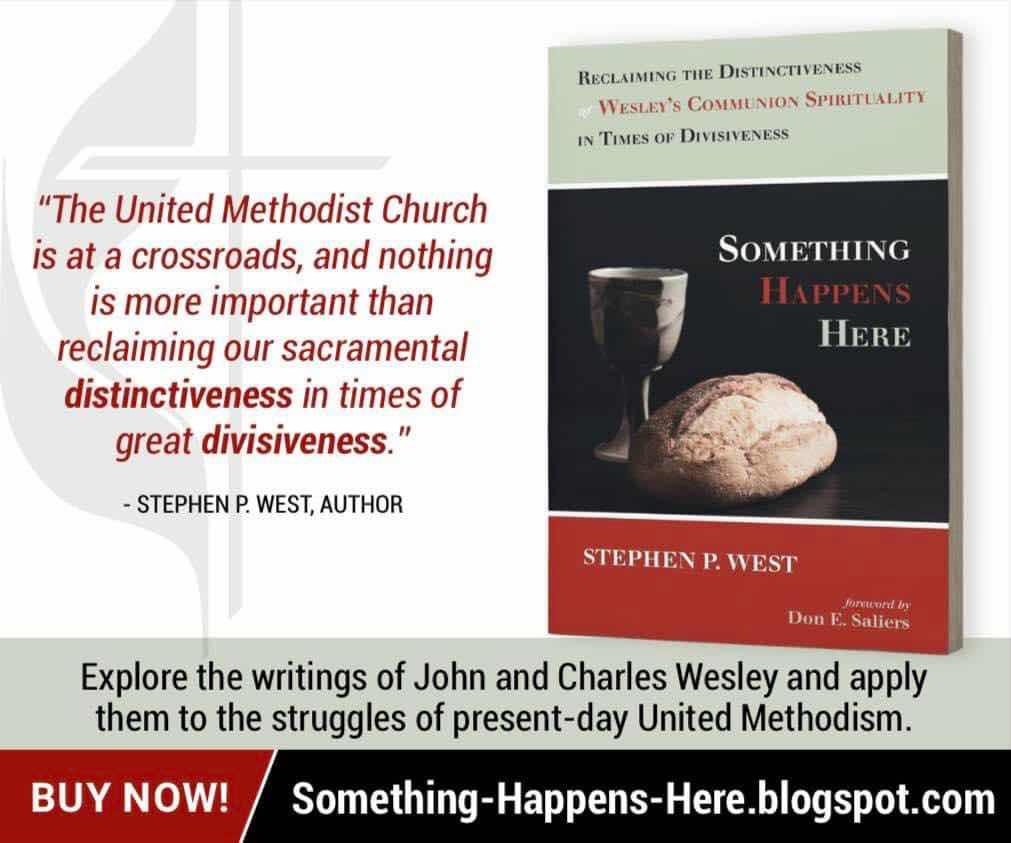
To celebrate a historic General Conference and uplifting Annual Conference, I’ve made my book available for a discount. Amazon and Wipf & Stock have it for $21. I’ll send you a copy for only $15 (with free shipping).
Just EMAIL ME or PRIVATE MESSAGE ME on Facebook with your address! I’ll send it with an invoice and you can pay me later.
If you really want to know why I was active in creating the “Stay UMC” movement, this book is about why.
Adam Ployd, professor and theologian at Wesley House in Cambridge, said, “This book is not so much a work of pure scholarship—though the author has clearly done his homework on the topic of Wesley and communion—as it is an exhortative reflection on the ways in which a robust Wesleyan vision of communion should shape the future of United Methodism. West sees a central problem at the heart of the crisis facing The United Methodist Church: it is being divided by political culture wars that threaten the integrity of the Body of Christ and the radical community it is called to be. The sacrament of Holy Communion, he believes, holds the theological and practical key to renewing the Body and cultivating community in a way that can allow the church to move forward in pious, charitable unity …
“Although West is writing for a popular audience— educated laity and clergy alike—this is an erudite book. West incorporates historical voices, from the earliest generations of Christians to the English Nonjurors and, of course, the Wesleys themselves, in order to educate his reader in some fairly nuanced theological ideas. He does so nimbly, demonstrating both his knowledge of the subject matter and his ability to communicate that knowledge with unusual clarity. Indeed, this is a book to be recommended to all United Methodists struggling with the current crisis who desire a rich, reliable theological resource for thinking about things in a way that transcends the surface-level issues.”
See the link Something Happens Here for more information.
Monday, March 11, 2024
"Where's the Fire?" Homily Shared at the Academy for Spiritual Formation

This is my homily that was shared at a recent Academy for Spiritual Formation at the Warren Willis camp, a United Methodist retreat center in central Florida. Reflecting on Macarius of Egypt as well as the story of my own grandfather, it's about discovering the fire within us, fueled by the fire of the Holy Spirit.
First Reading: 2 Corinthians 3:12-18 (“And all of us, with unveiled faces, seeing the glory of the Lord as though reflected in a mirror, are being transformed into the same image from one degree of glory to another.”)
Gospel Reading: Mark 9:2-8 (the transfiguration)
—
Sometimes I identify with Peter, not so much when he is doing well but when he is doing poorly. He starts his little speech with “It is good for us to be here,” which is what I catch myself saying when I have no idea how to start. It does say in Mark, “he did not know what to say, for they were terrified.”
So instead, let me start by telling you a story about my mother. She was an amazing person of faith. She was the daughter, sister, niece, wife, mother, and mother-in-law of Methodist pastors (the last one is because I married one). But SHE was the spiritual leader of our family.
I was one of four boys, and one of my early memories is of how she took my brothers to school, then she sat in a particular rocking chair in the kitchen with her morning coffee for about 45 minutes. She called it her “quiet time.” We were not to bother her during her quiet time! I vividly remember sitting on the couch, listening to her coffee cup click and click on the saucer, wondering when she was going to be finished.
I didn’t know it yet, but she was instilling a longing for God in me.
She was also the kind of person who planned for anything, and that’s where my story comes in. She had a funny habit; when staying at a hotel, the first thing she would do was make sure she knew where fire escape was. Know the type?
One time she and Dad went overseas, and they checked into a hotel. She couldn’t figure out where the fire escape was (there were unfamiliar markings in another language), so she started checking doors. She walked in on a fellow who was in a small restroom. “Oh, I’m sorry, I was just looking for the fire escape.” She quickly closed the door and kept looking.
A minute later, here came that fellow running down the hall, hurriedly pulling his pants up. He was yelling, “Where’s the fire? Where’s the fire?!”
Over the last few years, I’ve been asking myself that same question. Where’s the fire?
After a long Covid shutdown followed by an anti-science blowback, I was left asking, “where’s the fire?” After an uptick of racial tensions followed by extremist insurrection against our capital, and then after a rancor-filled season of division in my denomination, so many things have left me asking “Where’s the fire?”
I didn’t have to ask “where’s the dumpster fire?” We’ve seen plenty of those.
Where’s the fire that burns in the heart, the fire that changes the world?
I had no idea Dwight would teach us about Teilhard de Chardin saying, “Someday … we shall harness for God the energies of love, and then, for a second time in the history of the world, [humanity] will have discovered fire.”
THERE’S the fire. THAT’S the fire my soul longs for.
The word for the day is ENCOUNTERING. I want to introduce you to my friend here. These are icons of Macarius the Egyptian. These particular versions of the Macarius icon look less like Lew than the one I brought here a few years ago … these have more hair! But I chose these particular versions because of a common motif in Macarius icons … his HANDS are held up in the GLOW of God who is all light, all flame, and who illumines the soul.
Macarius was a 4th century monk, one of John Wesley’s favorite spiritual ancestors. We know this because Macarius’ book of fifty sermons were required reading for Wesley’s class leaders, and Wesley himself quoted him in his sermon “The Way of Salvation” when he describes “sanctifying grace.”
I read the sermons of Macarius. It changed my life.
This is partly because I discovered Macarius was the original source of Wesley’s theology of how grace comingles with our free will, and of what BOTH of them called Christian perfection (not flawlessness, but a journey of being perfected by the holiness of love).
Reading his sermons also changed my life because while Wesley used very exacting language (like “prevenient, justifying, and sanctifying grace”), Macarius used the most wonderful metaphorical language I ever heard, like our SOUL is a ship, or a moving throne, or a chariot with Christ as the charioteer, or a castle (yes, Teresa of Avila picked this up from Macarius and ran with it 12 centuries later).
Do you know what Macarius said about spiritual formation? We are all gathered around a FIRE. I invite you to hold your HANDS UP like Macarius, and hear his words:
“As many lights and burning lamps are lighted from fire, but the lamps and lights are lighted and shine from one nature, so also Christians are enkindled and shine from one nature, the divine fire, the Son of God, and they have their lamps burning in their hearts.”
Do you know what else he said about that lamp burning in each of our hearts, lit from the one fire? He said our SOUL is like a BRONZE vessel you put burning fuel under so the INSIDES are made warm. He adds, “So also grace, the heavenly fire, is also within you.”
The FIRE of the Holy Spirit burning under us becomes a heavenly fire that burns WITHIN us.
So … “where’s the fire?”
The word of the day is “encountering” and part of us LONGS for that kind of encounter with God - an encounter like Peter, James, and John on the mountain, or like Moses whose face was glowing from a personal encounter with GLOW of the great fire.
Let me tell you a personal story about finding that fire.
After a grueling few years of defending my annual conference from harm (some of you know my journey with the “Stay UMC” movement), one day I got out my Grandpa’s Bible.
I didn’t bring it today (it’s too fragile and priceless) but I keep in on my shelf. If I had time, I would tell you a story of Grandpa Hamby (he led a revival in the 1920’s, and brought pistols to the pulpit to defend the church against bootleggers who were trying to shut it down). It’s a colorful story … after all, I am from Alabama.
So I have his preaching Bible. (My uncle gave it to me when I was ordained). One day recently I got it out, and something dawned on me after all the pain of the last few years. I realized it was probably the SAME Bible that sat on that pulpit between those two pistols. But I had never gone through his sermon notes that were folded within its pages.
Well, a few weeks ago, I did. I found a particular one … it was entitled “Why I Love the Church.” Grandpa wrote:
“With all its admitted frailties and human weaknesses, we dare to join with David. Why did David so love the house of God? …
He shared a few thoughts, followed by this: “We love the Church because of what it cost. The Church is a costly institution. Its history is a story of divine and human sacrifice. Divine. Human. (He underlined these two words)
“Last of all, we love the Church because of its future. We are not manning a sinking ship. We are not fighting a losing battle.”
I then had one of those mystical experiences when I wondered if that was the very sermon he was preaching that day with two pistols on his pulpit to protect his church from getting shut down by those bootleggers. Was it his sermon on “why I love the church?”
What do you know. I would never take guns to church, but maybe it’s part of my spiritual DNA to “stick to my guns.”
What you also need to know is my Granny’s poem is in front of that Bible, written to my uncle on the eve of HIS ordination. I brought a picture so you can see. It’s entitled “Don’t Forget the Glow.”
This poem has always been dear to me, but now it’s taking on new life:
“I stood beside him proudly,
So much he’d learned to know.
And yet I dared to whisper,
‘Son, don’t forget the glow’.”
“The glow that feeds the hunger
In restless human breasts,
The glow that gives the answer
To life’s long, ceaseless quests.
“The glow that’s so rewarding,
When through the preach’d word
They breathe a prayer of ‘thanks, Sir’
For the wondrous things they’ve heard.
“Always put it in your message.
Hungry hearts, of God’s lost sheep,
Reaching out for strength and courage,
Need soul-food to climb the steep.
“The glow by which your father
Led countless souls to see
The ‘glow-ry’ of the gospel
As it’s surely meant to be.
“A diamond studded highway
Whose end is sure reward.
So keep it bright and shining,
The glory of his Word.”
Are you asking yourself “where’s the fire?” Are you longing for an ENCOUNTER with God?
There’s already a FIRE that burns beneath your “bronze vessel.” It’s the fire of God’s love. Our part is to fuel it with spiritual practices.
We didn’t START the fire. But if we keep the fuel coming, the holy fire grows hot. After simmering a while, we may find that the heat starts coming from within, too.
And when it does, well, don’t forget the glow.
In the name of the Father, the Son, and the Holy Spirit.
Sunday, January 29, 2023
“I’ll Be On My Way” by Shawn Kirchner
Some have asked me to share the audio recording my wife made of “I’ll Be On My Way” by Shawn Kirchner, performed by the Calhoun County Civic Chorale directed by JSU faculty member Dr. Eliezer Yansen, Jr.
I am the baritone soloist featured in the piece.
Thursday, September 15, 2022
Book Featured in North Alabama Conference communications

It reads:
"Communion has a way of shedding light on both who we really are and who we are called to be. It is an honest meal. We come to the table being real with God through confession, and Christ comes to us in real ways through his presence, hospitality and grace. The Lord’s Supper binds us together in ways beyond words, for it is a sacred act of both receiving the grace of God and being the body of Christ with one another."
These words come from the Prelude of a new book by North Alabama Conference pastor Rev. Dr. Steve West.
The book titled Something Happens Here: Reclaiming the Distinctiveness of Wesley's Communion Spirituality in Times of Divisiveness has the stated purpose of taking a careful look at John Wesley’s core teaching on the Lord’s Supper. The About this Book introduction explains, “Readers will grapple with the idea that Communion is not just a personal experience with Jesus but a feast that has huge implications for our life together. They will be given language to define themselves against sacramental theology colored by other denominations in their communities. Along the way, they will discover tools to thoughtfully sort through difficult conversations about divisive matters rather than settling into the either-or and ‘us against them’ mentalities that pervade national conversations about culture wars.”
Rev. West, the senior pastor of Jacksonville First UMC (Cheaha District), is descended from multiple generations of Methodist pastors and circuit riders. He has not only a deep belief in the church’s sacramental theology but also a great love of the United Methodist Church. He notes that he wants this book to be a timely resource for United Methodists as the denomination journeys through a season of conflict and division. In that spirit, he says he offers the book as a gift for God’s church and has committed to using 100% of proceeds to go back into promoting the book because he believes “it is so very timely for those who are part of the present journey of the United Methodist Church.”
The book is a scholarly work receiving praise from a variety of United Methodist scholars and authors. Rev. West says, “I hope it will be helpful for the classroom, thought-provoking for church study groups, lifegiving for pastors and church leaders, and accessible for anyone interested in what it means to bind ourselves to Christ and move forward with joy into the future God has in store for us.”
In Something Happens Here West explores the historical background of each core characteristic of Wesley’s communion teachings, finds evidence in the writings of John and Charles Wesley and applies them to the struggles of present-day United Methodism. The unique features of Wesley's communion theology become lenses readers can use as they navigate troubled waters. Chapters include Communion as a Prism, The Mystery of Presence, Experiencing Anew, Become All Flame, Foretaste of Heaven, Grand Channel of Grace, Becoming the Body and Reconnecting. West concludes the book with signs of life emerging as people come back to the Lord's table to move forward into the future.
West writes, “The table is a radical table, because it brings us back to what connects us, which is not agreement or like-minded thinking but community and love-minded thinking. We are bound by our belief, yes, but I’m reminded that in early English, the word 'belief' was pronounced ‘by life.’ How we love those we don’t agree with is the very definition of Christian fellowship.”
The book is available from Amazon or Wipf and Stock Publishers. The book is also available for sale by the author. For a signed copy, see the author or send a check for $22 plus $3 shipping (total $25) to Steve West, 313 2nd Street NE, Jacksonville, AL 36265.
Wednesday, September 7, 2022
Review by Rev. Steve Harper
I’m honored by this recommendation and book review by Rev. Steve Harper, author and retired elder from the Florida Conference, former seminary professor at Asbury, blogger at Oboedire, and important voice in the UMC.

Honestly, I’m in tears this morning.
You can find his original Facebook post here. It is reprinted below.

"Something Happens Here--Be Part of It."
Steve Harper
For some time, I have believed that the increase of divisiveness in The United Methodist Church (and the larger Christian community) is, in part, due to a decrease in our theology and practice of Holy Comnunion. When we stop coming to the Table together, we open the door to separatism that can too easily turn toxic.
And worse, when some divide so severely that they are willing to speak and write about excluding people from the Table, they have reversed the intention of Jesus for the holy meal to bring us together, counterfitting Communion, making it exclusionary, and using it to legitimize and widen the divide.
Conversely, I also believe that the renewal of the United Methodist Church (and the larger Christian community) must include a recovered theology of the Lord's Supper and a revived partaking of it. I believe the new awakening is eucharistic.
What I have only discovered recently is that Steve West not only believes this, he has written a book about it--a book which weaves together multiple threads of sacramental theology to offer us a eucharistic coat of many colors, complete with a winsome invitation to put it on. I have not seen a book that combines the various elements of sacramental theology the way his does.
Rooted in the Bible and in the Wesleys' words and hymns, West offers insights as ancient as Macarius the Egyptian and modern as John Pavlovitz. Along the way, his own pastoral experience with the sacrament puts flesh on the conceptual bones, sometimes in surprising and moving ways--the first story in the book serving that purpose in spades.
West's title, 'Something Happens Here' sums it up. And after you read his book, you will find yourself saying, "It is something that needs to happen again, here and now." And more, you will find yourself drawn into a mission to make it so.
--
The book may be found on Amazon or Wipf & Stock.
Monday, September 5, 2022
Featured in the Sewanee Theolog Gazette

I'm honored that the new book was featured in the Sewanee Theolog Gazette this month. You can find the August 2022 issue here with reference to the book under the section entitled "Notable."
Here is an excerpt from the book that shares an experience I had on campus.
EXCERPT - "Something Happens Here" by Stephen P. West
For four years, I spent three weeks of summer intensives at the beautiful campus of Sewanee: The University of the South in Tennessee, which I affectionately call “Hogwarts on the mountain.” By the third year, I was close to completing the twenty-mile Perimeter Trail around the crest of the mountain. The language of finding a “way forward” had become common in Methodist leadership circles, since we were approaching a called General Conference that was supposed to find some level of resolve over the deepening divide regarding matters of human sexuality. This annual trek was becoming a prayer walk, as I became intentional to pray about the “way forward” as I walked this path. One afternoon after class, I found myself taking a break from my routine hike to check out a natural bridge I had heard about on another part of the campus.
As I walked down the hill to look over this bridge that had developed purely out of divine initiative, I was whisked away into a mystical experience. I climbed to the top of the bridge and crossed over, pondering the concept of finding a “way forward.” Jesus called himself the “way.” He did not say he would show us the way, or tell us about the path, or send us on our journey, but that he is the way. I don’t believe he said this to be exclusive, as it is often interpreted. I believe he said this to remind us that following him is a journey, and the wisdom of God is a path that will take us to new places and new spaces. Christianity is not a list of rules to follow or a set of doctrines to swallow but a relationship with the divine one who is fully embodied in the person of Christ Jesus. We did not need to build a bridge to provide a way forward. It is a gift given to us in Christ. After all, before Christians were called Christians, the movement was simply called “the Way.”
Just as he began his disciples’ journey with the call to “follow me” (Matt 4:19, italics added), he intentionally prepared them for the completion of his earthly life with a meal invitation to “do this in remembrance of me” (Luke 22:19, italics added). As I have said, it is not a call to simply remember a meal, a liturgy, or a lesson on the meaning of the cross but to reexperience me . . . all of me. The invitation at the table completes what could be seen as a two-part calling of the disciples. Life at the table takes us much deeper into the heart of what it means to truly follow. On that natural bridge, I determined that no matter what, wherever this path took me, I would choose the way of Christ. How Christ behaved toward others is the best lens through which we interpret Scripture, even his own words. Christian spirituality is embodied spirituality, and in Christ, the “fullness of deity dwells bodily.” Jesus offered the invitation at the table when he knew the time was coming soon when he was no longer going to walk on earth. We were to become the hands and feet of Christ.
Wednesday, August 31, 2022
Author Interview by United Methodist Insight

It's entitled "'Musical Preacher' Pens Book on Communion as Way to UMC Unity" and it can be found here.
This United Methodist Insight exclusive begins with these words:
"In these days of church turmoil, it may be hard to find someone more in love with the blessings of Methodist heritage than the Rev. Dr. Stephen P. West. That's a good thing, because out of his service as a pastor, his affinity to Charles Wesley's hymns and his doctoral project he has written a book about the heart of Methodism - the sacrament of Holy Communion."
Again, you can find the book on Amazon or Wipf & Stock.
Wednesday, November 10, 2021
What’s Distinctive about Wesley’s Communion Spirituality?
This was my presentation “Taste and See” at Bluff Park UMC this morning. What an honor to be back at one of my “home churches.”
It is on FIVE WORDS that describe what is distinctive about Wesley’s communion spirituality:
1. Presence (sure and real)
2. Remembrance (experience anew)
3. Perfection (in love)
4. Foretaste (of heaven)
5. Becoming (the body)
Wednesday, June 30, 2021
Coming to Communion in an “Unworthy Manner”

When I posted the attached picture on Facebook, I got a question from a friend. I succinctly responded to what I think is one of the biggest misinterpretations of Paul’s communion theology today. I thought it would be good to share it here as well.
Here was his question:
Here was my response:
That’s a great question and the scriptural context makes the answer very clear with what Wesley called a “plain reading” of the text. I studied this in my doctoral work.
Paul is not talking about some sense of individual worth or personal morality as many have imagined, but rather he is talking about ethics within the community. The context of 1 Corinthians 11 is that there were divisions in the community (the whole book is about that starting with chapter 1), and in that very chapter 11, Paul was criticizing the way these divisions were made evident even when they gathered at communion (“when you gather, it’s not the Lord’s supper that you eat, for one goes hungry while the other is drunk”). They were not sharing their food and wine, they were not regarding one another with love, they were quite comfortable with the difference in status they had from each other.
What he saw at the communion table becomes a prism through which he looks at the lack of love for each other beneath the surface. He goes on in chapter 12 to teach them how each of them have different gifts, like parts of the body, therefore they should appreciate each other as valuable. Then he says “let me show you an even more excellent way,” and he goes to chapter 13 into the “love chapter” in which he describes what true love is (we like to read this at weddings but what he was addressing was spiritual arrogance and church conflict ... “if I speak in the tongues of people and angels but do not have love, I am nothing but a noisy gong”.) Then in chapter 14, he directly addresses the spiritual arrogance they had against each other. Chapters 11-14 should be read as one block of teaching.
Clearly, when Paul wrote what you quoted he was talking about how they treated each other without love and appreciation and a sense of community. That’s what coming to the table in an unworthy manner is. Not some human line drawn in the sand over what you believe or don’t believe, or what sin is bad enough and what isn’t.
Those who exclude people who earnestly seek God from the table may be the ones guilty of not coming to the table in a worthy manner.
He replied:
I've never heard of any of us Methodist Pastors excluding anyone, have you?
I responded:
No, the open table is central to Wesleyan theology, you are right.
However, I have heard of Methodist ministers excluding people from membership or attendance or baptism, whether back during the 60’s or in recent days, and that is by proxy excluding them from the table. This is against our Discipline not to mention wrong.
Monday, April 5, 2021
Every Morning is Easter Morning!
I woke up with this song on my mind from Sumatanga days! May Easter go with you in the coming days!

Ev'ry morning is Easter morning
from now on!
Ev'ry day's resurrection day,
the past is over and gone!
Goodbye guilt, goodbye fear, good riddance!
Hello Lord, Hello sun!
I am one of the Easter People!
My new life has begun!
Daily news is so bad it seems the
Good News seldom gets heard.
Get it straight from the Easter People:
God's in charge! Spread the word!
Yesterday I was bored and lonely;
but today look and see!
I belong to the Easter People!
Life's exciting to me!
Ev'ry morning is Easter morning
from now on!
Ev'ry day's resurrection day,
the past is over and gone!
Ev'ry morning is Easter morning,
Ev'ry morning is Easter morning,
Ev'ry morning is Easter morning
from now on!
Richard Avery and Donald Marsh, Words © 1972 Hope Publishing Company, 380 S Main Pl, Carol Stream, IL 60188
Wednesday, March 24, 2021
Thoughts on Marriage

I found this today in a devotional book I've had for a number of years based on the writings of Dietrich Bonhoeffer. I thought it was beautiful and expresses my thoughts on marriage.
“Marriage is more than your love for each other. It has a higher dignity and power, for it is God’s holy ordinance, through which God wills to perpetuate the human race till the end of time. In our love you see only your two selves in the world, but in marriage you are a link in the chain of the generations, which God causes to come and to pass away to God’s glory, and calls into the kingdom. In your love you see only the heaven of your happiness, but in marriage you are placed at a post of responsibility toward the world and humanity. Your love is your own private possession, but marriage is more than something personal – it is a status, an office. Just as it is the crown, and not merely the will to rule, that makes the king, so it is marriage, and not merely your love for each other, that joins you together in the sight of God and humanity. As you first gave the ring to one another and have now received it a second time from the hand of the pastor, so love comes from you, but marriage from above, from God. As high as God is above humanity, so high are the sanctity, the rights, and the promise of marriage above the sanctity, the rights, and the promise of love. It is not your love that sustains the marriage, but from now on, the marriage that sustains your love.”
Dietrich Bonhoeffer, Letters and Papers from Prison (pp. 27-28)
Tuesday, February 9, 2021
Praying the Psalms

I love the spirituality of diligently keeping up with a prayer list as a community and lifting those names not only in the newsletter, but as part of heartfelt Sunday morning prayers led by staff. I love the warmth and close proximity of the prayer room which focuses my prayerfulness before and after services, when I’m recording midweek devotions, and whenever I just need to go there to be still and know.
I also love the way this church is accustomed to making the psalms part of morning worship, as well as psalms being embedded in the lyrics of worship songs at Thrive. The psalms call our community to prayer. The psalms are the prayer book of the Church as well as of our ancestors in faith. Jesus had these prayers on his lips and in his heart. Christians keep praying the psalms, and will do so for the expanse of time, in ways that take prayer beyond words.
Whether our personal feelings at any given moment are articulated in a particular phrase, the psalms express the prayers and honest feelings of the whole Church across the world and across time. They give our prayers language and context. They connect us with the ongoing praise and prayer of all creation.
I ran across this good word in my morning devotions, from the martyr Dietrich Bonhoeffer whose deep and biblical spirituality led him to stand firmly against the realities of political evil. I share this with you today from his book Life Together.
“The Psalter is the vicarious prayer of Christ for his congregation. Now that Christ is with the Father, the new humanity of Christ - the body of Christ - on earth continues to pray his prayer to the end of time. This prayer belongs not only to the individual member, but to the whole body of Christ. All the things of which the Psalter speaks, which individuals can never fully comprehend and call their own, live only in the whole Christ. That is why the prayer of the Psalms belongs in the community in a special way. Even if a verse or a psalm is not my own prayer, it is nevertheless the prayer of another member of the community; and it is quite certainly the prayer of the truly human Jesus Christ and his body on earth.”
If you are new to praying the Psalms, spend time every morning for a few days praying Psalm 63. That’s a good place to start. Let the words sink in to the very depths of your soul and articulate your thirst for God.
Friday, December 25, 2020
"The Hay that Heals" - St. Francis and the First Live Nativity

This is a written version of my second Christmas Eve meditation on December 24, 2020. Because of the pandemic, we met for livestream-only worship in the sanctuary, followed by outdoor communion serving and candlelight circle. I shared this meditation on St. Francis by the manger scene outdoors.
Earlier tonight, we gathered virtually by livestream to ponder the scripture, enjoy the music, and explore the meditations of this holy season. We joined in the Great Thanksgiving at the table of grace. Now we gather outdoors to receive this blessed communion and create a candlelight circle. And we do so around this manger for a reason.
Have you heard the origins of the manger scene? The manger scene was created by St. Francis of Assisi.
Francis, who was born into merchant family in Assisi of modern-day Italy, rejected his family’s wealth and even cast off his expensive garments in a public square. He founded the Franciscans, a movement that is dedicated to works of charity with the poor and marginalized. He was, of course, known as a lover of animals and all God’s creation.
In 1223, St. Francis did something special to kindle devotion on the birth of Christ, God’s concern for the poor and oppressed, and God’s love for the animal kingdom. He created the first live nativity. A generation later, in the year 1291, the first pope that was from the new Franciscan order had a permanent manger scene placed in front of one of Europe’s churches. That began the tradition of carved manger scenes we still enjoy today.
But that very first live nativity scene set up by St. Francis himself was placed near the town square. A real manger was placed there with hay, with Mary and Joseph, a carved baby Jesus doll, an ox, and an ass. Francis invited the villagers to come and gaze on the scene while he preached on the “babe of Bethlehem” (they say he was so overcome with joy, he could not say the name “Jesus”).
One witness said the wooden doll of the baby Jesus appeared to cry tears of joy and “seemed to be awakened from sleep when the blessed Father Francis embraced Him in both arms.”
There was another miracle, too, a miracle that I invite us to get our hearts in touch with during this pandemic. I call it the legend of “hay that heals.” The story is that the hay in the manger, from this very first live nativity, healed sick animals and protected people from disease.
We gather outside tonight in the middle of a world-wide pandemic that has changed our gatherings but will not kill our spirits. And we gather because of the healing power of the one who was laid in a manger.
Our staff prepared a little cluster of hay to give each family tonight. We share it with all of us who have come and gathered safely outdoors for closing communion by candlelight.
I invite your family to ponder your little bundle of hay. I invite you to place it under your tree, or on your mantle, or under your centerpiece on this most unusual Christmas Day. Tell others the story of St. Francis and the first manger scene. Recall the legend of the “hay that heals.”
We share this little gift because our world need healing right now, more than ever. We pray that the healing that pours out from the manger of grace will touch us in every broken place.
Thursday, December 24, 2020
"O Holy Night" - A Super-Charged Political Statement

This is a written version of my first Christmas Eve meditation on December 24, 2020. Because of the pandemic, we met for livestream-only worship in the sanctuary, followed by outdoor communion serving and closing candlelight circle. I shared a separate meditation later by the manger scene outdoors.
Did you know the classic Christmas song, "O Holy Night," contains a political statement that was bold and brazen for its time?
On Monday, many of us gazed into the sky and saw what has been dubbed the “Christmas Star.” Since this rare conjunction of planets is one way astronomers say God might have sent us the star of Bethlehem, I took it as a sign of hope in difficult times. How wonderful that for us, the "Christmas Star" happened to appear on the longest night of year. It’s been a year which has felt like one long night.
As I woke up Monday morning in what seemed like utter darkness, the song “O Holy Night” popped into my head. On the day of our darkest night, the first thing on my mind was the holiest of nights. So I did a little research.
Did you know “O Holy Night” was written in 1847? The text was written in the French language bv the French poet Placide Cappeau and set to music by French composer Adolph Adam. It wasn't translated into English until 1855.
Obviously, the major social issue blazing in the world in 1847 was slavery, and that's not just what was boiling in the United States. In fact, the following year, 1848, was the year slavery was finally abolished in France and the French colonies.
This simple fact deepens the impact of the last verse of "O Holy Night":
Truly He taught us to love one another;
His law is Love and His gospel is Peace;
Chains shall he break, for the slave is our brother,
And in his name all oppression shall cease, …
That was a daring and direct statement with political implications! When the world was enraged and even on the brink of war over slavery, they openly sang that "the slave is our brother" and that in Christ's holy name, all such oppression shall cease. Period.
This gives us an angle on Luke's second chapter tonight. The very first "Christmas carols" in history - the canticles of Mary, Zechariah, and Simeon recorded in Luke - all sing that the coming of the Messiah had everything to do with God's concern for the lowly, the poor, the oppressed, and the marginalized.
That’s why Jesus was born in poverty. That’s why he came from a technically unwed mother. That's why his family didn’t have the connections to find a decent room when traveling to Bethlehem. That’s why they laid the baby Jesus in a messy feeding trough full of hay, and that’s why they were visited by smelly shepherds who’d been working all night long.
God adores the poor and lowly, the needy and oppressed. So in God's odd way of saving the world, God became one of them, so that Christ might save us all.
This year, which has felt like one long night, has been a year when we’ve been acutely aware of stubbornness of systemic racism, and yet we worship the one in whose name all oppression shall cease. This year, when politics have been so divisive, we worship the one whose gospel is peace. This year, when some of us live on the brink of religious division, we worship the one whose law is love. This year, when we have been dealing with the blows of a world-wide pandemic, we worship the one who taught us to love one another.
This holy child, this Messiah, this savior, this prince of peace came to not only show us what true love is, but to bust open the door holding back God's radical grace. The singers of these songs can see that the love of God saves the whole world, but especially pours out upon the places and spaces love hasn't been reaching.
May it reach you tonight.
Monday, December 21, 2020
O Holy Night
This is a Christmas gift for you, my friends, on the longest night of the year. Blessings.
Tuesday, December 15, 2020
Spirit of Christmas
This is an original Christmas carol to share with you, my friends.
May you have a blessed and wonder-filled season.
I wrote it years ago during seminary, when I was enrolled in a class on the history of Christian thought with Drs. Roberta Bondi and Bill Mallard (and sitting next to an attractive young woman named Sandy O'Quinn who I was not yet married to). We were studying Athanasius, who was very influential in the 4th century in clarifying the doctrine of the incarnation. He was well known for the idea that God in Christ came down from above that we might be brought from below.
For more on Athanasius see this article.
Saturday, May 2, 2020
Making Worship Youth-Friendly

It was entitled "Making Worship Youth-Friendly," and I wrote it when I was on staff at Vestavia Hills UMC as Associate Pastor and Minister of Youth and Worship.
I still believe much of what I have written here, though I would definitely say things differently now.
As she left the sanctuary after the Youth Sunday service, she asked me, "is there going to be preaching at the next service? I haven't 'been to church' yet!" This was the most creative Youth Sunday service we'd ever had; but for her, it wasn't "church." On the other hand, passing out parts to read on Youth Sunday doesn't feel like "church" either.
Sunday worship in the average congregation is "R-rated"; it is for adults only. As pastors charged with leading the worship of the Christian community, how can we make worship more "youth-friendly" without compromising the integrity of the liturgical tradition?
Why Change?
Worship is where memory meets practice. The memory of grace through history, celebrated through sacred stories, symbols, and acts, meets our everyday fears. hopes, experiences, and dreams. In worship, God meets us and we meet God. So renewal in worship must happen precisely because of its purpose, which is bringing the gospel to bear on modern experience.
We tend to see youth as basically nontraditional and bored with anything that looks or sounds "old." Sometimes, in an attempt to appeal to a new generation, we try to replace traditional liturgy with something "new."
Boredom with the old and fascination with the new is not the way to make worship youth-friendly. First, it departs from the power of the commonality and familiarity of the liturgy. In a world where youth are exposed to myriad images, ideas, conflicts, and choices, worship is a "sanctuary" for adolescents. It is a place of comfort and familiarity, where they can come home. Second, the attempt to give up on traditional liturgy is based on an inaccurate assessment of the needs of today's youth.
The emerging generation of Millennials (those born after 1982, some of whom are now entering their teens) are more "civic oriented" than their immediate predecessors. In practical terms, this means that they will value optimism, cooperation, community, structure, and tradition. Efforts to form a liturgy that assumes that youth are cynical about tradition are outdated.
I am not surprised to find Millennials described as neo-traditional. More and more, I have found that youth have a loving relationship with tradition. They simply want to be a part of making it. To make worship more meaningful for a new generation of youth, we must go deep into our past and discover where it meets with our experience in the present. We can do this in at least three ways:
Take a New Look
In our quest for innovation, we must remember that our own tradition is our best resource for change. Millennial youth will find greater value in the central structures of worship, such as creeds, psalms, the sacraments, and traditional forms of prayer. However, we need to find new ways to revisit these elements creatively, as if exploring them for the first time. It is important for youth to experience a balanced diet of the new and the old in hymns, music, prayers, and other acts of worship as they connect their lives with our common memory of God's work in the world.
Plan Experiential Worship
Today's youth receive and process most of their information in fast-moving visual and audio images. It is no surprise, then, that Millennial youth are described as activity- and experience-oriented. Our youth will help us rediscover that when we worship, we are doing something, and we are doing it together.
Responsive singing, reading, and praying will be more and more meaningful for our young people. We will need to explore or re-explore forms of communication such as drama, dance, television, congregational movement, and electronic art in worship as these provide opportunities for experiential participation. Our sermons will need to be planned knowing that youth respond better to meaningful images than to formulated doctrinal statements (so do adults, for that matter).
Be Youth-Inclusive
If the trends are correct, youth will increasingly want to move from the periphery to the center of involvement in the worship life of congregations. It is no secret that youth learn more through involvement than through any other form of education. They need to be included at all levels of planning and organizing. Youth choirs, when available, need to participate regularly in Sunday worship. Youth leaders need to be called on to assist younger choirs. Sacred dance and visual art groups are other creative opportunities for involvement. Youth also enjoy instrumental music and may be able to contribute in that arena. Serving as lay liturgists or ushers is another important option for youth. We must also be careful as leaders of worship to make sure our language is intentionally inclusive (for example, youth are not just "our future," they are part of the present congregation).
Worship is, by definition, both expressive of who we are and formative for spiritual growth. So all worship planning must keep our diversity in mind as we discover the needs of the youth among us. The practice of old traditions and the development of new traditions, along with experiential involvement by youth in the worship life of the congregation, are a must for "youth-friendly" worship.
Originally published in Circuit Rider: For United Methodist Clergy from The United Methodist Publishing House in March 1995.

Subscribe to:
Posts (Atom)