Showing posts with label Wesley. Show all posts

Wednesday, May 14, 2025

What United Methodists Believe


The local church I’m departing from next month will be revamping its website soon after I start my new adventure as a chaplain in Birmingham. I thought I’d capture the article I wrote for the church's website on basic Methodist beliefs and post it here. I’ve worked on this wording for years, and I’d love to share it with you!

What Do United Methodists Believe?

The United Methodist Church is a 10 million member world-wide denomination, the largest of many denominations in the Methodist faith family that total approximately 80 million people in the world. The United Methodist Church is the second largest protestant denomination in the United States, and the most evenly wide spread. We love our denomination, but we live for Jesus Christ. We follow the passionate, heart-warming spirituality of the English reformers John and Charles Wesley.

We do not believe that we are “right” and everyone else is “wrong.” But we have a unique flavor. Methodists believe that while we are sinners in need of grace, our most essential identity is that we are beautifully created in the image of God. We trust in the expansive nature of God’s grace, which reaches to us before we even know it and continues to transform us long after we embrace it. We believe that God gives us the free will to respond, and we cooperate with God through spiritual practices such as scripture, prayer, worship and sacraments, sacrificing for God, and developing Christian relationships to hold us accountable. These are the “methods” of Methodism, the ways we open ourselves to God’s incredible grace.

Jesus calls us to be followers, not just fans, and personal relationship with Christ nourishes us for that great adventure. We believe in the essential nature of God as Trinity (Father, Son, and Holy Spirit). We affirm that the scripture is the inspired revelation of God, and we believe that Jesus Christ is the Word made flesh to dwell among us. We assume that faith is informed by a healthy balance of scripture, tradition, reason, and experience. We believe that faith in Christ warms the heart and changes the world around us.

There is an excellent website on United Methodist beliefs which includes sections on basics of faith, sacraments, and spiritual living. Check out What We Believe.

Interested in more?

Here are some thoughts and reflections for those who would like to know more about Methodist beliefs.

The Christian church is like a river, with Jesus Christ as its source. In time the river has divided into smaller rivers and tributaries. But like a river, as travelers move upstream, they will find their way back to the source, Jesus Christ.

Traditionally, Wesleyan Christians have emphasized the following:

  • - God reaches us with immeasurable grace. Grace is active in our lives long before we respond, transforms us in faith, and makes us more complete through a lifelong journey. Wesley called these ways of grace prevenient grace, justifying grace, and sanctifying grace.

  • - God gave us the gift of free will. We are called to respond to the graceful initiative of God in our lives.

  • - God will comfort, guide, and forgive every person, no matter who they are or what they’ve done.

  • - Our faith is one of the head, the heart, and the hands. We are called to serve.

  • - We find spiritual fulfillment in the balance of solitary moments of reflection and the activities of a community of faith.

  • - Faith is about love, not about being “right.” In essentials, we have unity. In non-essentials, we value diversity. In all things, we are called to be people of self-giving love.

  • - We are a global movement that’s making a difference in the world. The Church is bigger than we are. We are part of the Body of Christ.

In practice, we are similar to other Protestant denominations, affirming our beliefs through the sacred acts of baptism and communion. For us, these are sacraments, the outward and visible signs of inward and spiritual grace. They aren’t just object lessons. Something happens here.

Through baptism, we accept God’s gift of grace. People of any age may be baptized, including infants who receive the prevenient grace of God. We recognize the baptisms of any Christian faith tradition, and we do not rebaptize those who come into the Methodist faith. There is no requirement among United Methodists about how baptism must be performed, although sprinkling is most common.

Everyone is accepted at the communion table, whether members of the Church or not, whether children or adults. This table is a table of grace and all are welcome. Communion is both a sacred experience with God and a celebration of our community life together. We are always becoming the Body of Christ in the mystery of God’s grace.

The history of United Methodism can be traced back to John Wesley, an Anglican priest who felt his own heart “strangely warmed” with an assurance of God’s love nearly three centuries ago. After this experience, he began a movement of “religion of the heart” along with his brother Charles, a musician and pastor in his own right. The early Methodist movement was based on the expansion of small groups within societies, holding each other gently accountable for their discipleship. It spread like fire through circuit riding preachers on horseback. Their work launched a movement that spread rapidly in the American colonies and took hold with a fervor that still exists almost 300 years later.

During that time, our hearts have led us to build many schools as well as churches. Methodists were among the first to create institutions of learning for settlers, women, and newly freed slaves. There are now 120 United Methodist educational institutions, including schools outside the U.S., most notably Africa University in Zimbabwe. But countless other schools, as large as Auburn University, were Methodist schools at one time.

Today, United Methodists comprise the second largest Protestant denomination in the United States. Our churches are connected by a system to guide our work and govern our policies. We continue to take the lead in social, spiritual, and moral concerns. In the tradition of John and Charles Wesley, our members study scripture, encourage thoughtful debate, and confront the tough issues of the day. We still lead with our hearts, keep our minds open, and welcome everyone through our doors.

Wednesday, June 12, 2024

Making My Book Available for Discount


To celebrate a historic General Conference and uplifting Annual Conference, I’ve made my book available for a discount. Amazon and Wipf & Stock have it for $21. I’ll send you a copy for only $15 (with free shipping).


Just EMAIL ME or PRIVATE MESSAGE ME on Facebook with your address! I’ll send it with an invoice and you can pay me later.


If you really want to know why I was active in creating the “Stay UMC” movement, this book is about why.


Adam Ployd, professor and theologian at Wesley House in Cambridge, said, “This book is not so much a work of pure scholarship—though the author has clearly done his homework on the topic of Wesley and communion—as it is an exhortative reflection on the ways in which a robust Wesleyan vision of communion should shape the future of United Methodism. West sees a central problem at the heart of the crisis facing The United Methodist Church: it is being divided by political culture wars that threaten the integrity of the Body of Christ and the radical community it is called to be. The sacrament of Holy Communion, he believes, holds the theological and practical key to renewing the Body and cultivating community in a way that can allow the church to move forward in pious, charitable unity …


“Although West is writing for a popular audience— educated laity and clergy alike—this is an erudite book. West incorporates historical voices, from the earliest generations of Christians to the English Nonjurors and, of course, the Wesleys themselves, in order to educate his reader in some fairly nuanced theological ideas. He does so nimbly, demonstrating both his knowledge of the subject matter and his ability to communicate that knowledge with unusual clarity. Indeed, this is a book to be recommended to all United Methodists struggling with the current crisis who desire a rich, reliable theological resource for thinking about things in a way that transcends the surface-level issues.”


See the link Something Happens Here for more information.

Sunday, May 26, 2024

Wesley wasn’t “converted” at Aldersgate

I have an Episcopalian friend who remarked that it bothered him that people call the Aldersgate experience Wesley’s “conversion”. He’s absolutely right. This is what I wrote in the comments and I want to share it here.

I always balk and correct people when they call the Aldersgate experience Wesley’s “conversion.” You are absolutely on target, that’s reading Wesley through revivalist eyes. That’s saying he wasn’t really a Christian before then, like he wasn’t really “saved.” 

He was in fact quite faithful, studied, and an Anglican missionary in Georgia.

He did not claim that he got “saved” at Aldersgate. His entire theology of the lifelong journey of experiencing prevenient, justifying, and sanctifying grace is in fact what Wesley called “the scripture way of salvation.”

It is far more accurate to say this was a very powerful experience of assurance. “An assurance was given me,” he said, a new peace that he did not have to work so hard. Christian life is about grace. I suppose for some revivalists, this assurance is their definition of “getting saved.” But it wasn’t Wesley’s.

It is important, though, and I would press you back (while completely agreeing about the ridiculous idea that this was his “conversion”) that this experience placed a fire in his belly that became the Methodist movement. It was indeed a turnaround from a perceived sense of failure. He was run off from Georgia, yes, by the family of Sophie Hopky and related legal troubles. But not because he was a general failure as a Christian.

But more fundamentally, it was a vivid personal experience of the “heart religion” he already admired and had seen in the Moravians, and which his brother Charles had experienced the year before.

To use his words, Aldersgate was not an experience of justifying grace (conversion). It was his most vivid experience of sanctifying grace. And that turned his inner light on, with the rest of his life committed to help other people grow in holiness.

Wednesday, December 14, 2022

Charles Wesley's Words Against Separation


This article was shared with me by S T Kimbrough, Jr.

A key sentences reads "Regardless of current opinions in the church, remembering the posture of our founders is essential if we would bear the name Methodist."

Kimbrough  is a retired NAC member of the North Alabama Conference and serves as a Research Fellow in the Center for Studies in the Wesleyan Tradition at Duke Divinity School


At the conclusion of John Wesley’s treatise Reasons Against Separation from the Church of England (1758) there is a rarely quoted paragraph written by his brother Charles Wesley. As one carefully considers issues related to dividing The United Methodist Church it behooves us to hear these words of one of the founders of the Methodist movement.

        “I think myself bound in duty, to add my testimony to my brother’s.
    His twelve reasons against our ever Separating from the Church of England,
    are mine also. I subscribe to them with all my heart. Only with regard to the
    first, I am quite clear, that it is neither expedient, nor lawful for me to
    separate: and I never had the least inclination or temptation so to do. My
    affection for the Church is as strong as ever; and I clearly see my calling;
    which is, to live and to die in her communion. This therefore, I am determined
    to do, the Lord being my helper.

        I have subjoined the Hymns for the Lay-Preachers; still farther to secure
    this end, to cut off all jealously and suspicion from our friends, or hope from
    our enemies, of our having any design of ever separating from the Church.
    I have no secret reserve, or distant thought of it. I never had. Would to God
    all the Methodist preachers were, in this respect, like minded with
                                                                                        CHARLES WESLEY.”

Following this statement Charles included a series of hymns and poems pertinent to this theme. I quote only one of them here. Regardless of current opinions in the church, remembering the posture of our founders is essential if we would bear the name Methodist. As “God is love,” the Wesleys remind us that this is the central force of individual and corporate life together. Charles reminds us that God transcends the opinions of our hearts: thou art greater than our heart. And humble love is to be our ongoing mark as followers of Jesus. In the current turmoil in United Methodism the deep sense of humble love in the spirit of Charles Wesley’s text below, alone is worthy of the people called Methodists who claim to be followers of Christ.

                    O Lord, our strength and righteousness,
                        Our base, and head, and corner-stone,
                    Our peace with God, our mutual peace,
                        Unite, and keep thy servants one,
                    That while we speak in Jesus’ name,
                    We all may speak, and think the same.

                    That spirit of love to each impart,
                        That fervent mind, which was in thee,
                    So shall we all our strength exert,
                        In heart, and word, and deed agree
                    T’ advance the kingdom of thy grace,
                    And spread thine everlasting praise.

                    O never may the Fiend steal in,
                        Or one unstable soul deceive:
                    Assailed by our besetting sin,
                        And tempted ’fore the work to leave,
                    Preserve us, Lord, from self and pride,
                    And let nor life, nor death divide.

                    Pride, only pride, can cause divorce,
                        Can separate ’twixt our souls and thee:
                    Pride, only pride, is discord’s source,
                        The bane of peace and charity;
                    But us it never more shall part,
                    For thou art greater than our heart.

                    Wherefore to thine almighty hand
                        The keeping of our hearts we give,
                    Firm in one mind and spirit stand,
                        To thee, and to each other cleave,
                    Fixed on the Rock which cannot move,
                    And meekly safe in humble love.

S T Kimbrough, Jr., retired NAC member

Thursday, September 15, 2022

Book Featured in North Alabama Conference communications

I'm honored that my book was featured in communications of the North Alabama Conference of the United Methodist Church this week. You can find the original article original article here

It reads:

"Communion has a way of shedding light on both who we really are and who we are called to be. It is an honest meal. We come to the table being real with God through confession, and Christ comes to us in real ways through his presence, hospitality and grace. The Lord’s Supper binds us together in ways beyond words, for it is a sacred act of both receiving the grace of God and being the body of Christ with one another."

These words come from the Prelude of a new book by North Alabama Conference pastor Rev. Dr. Steve West.

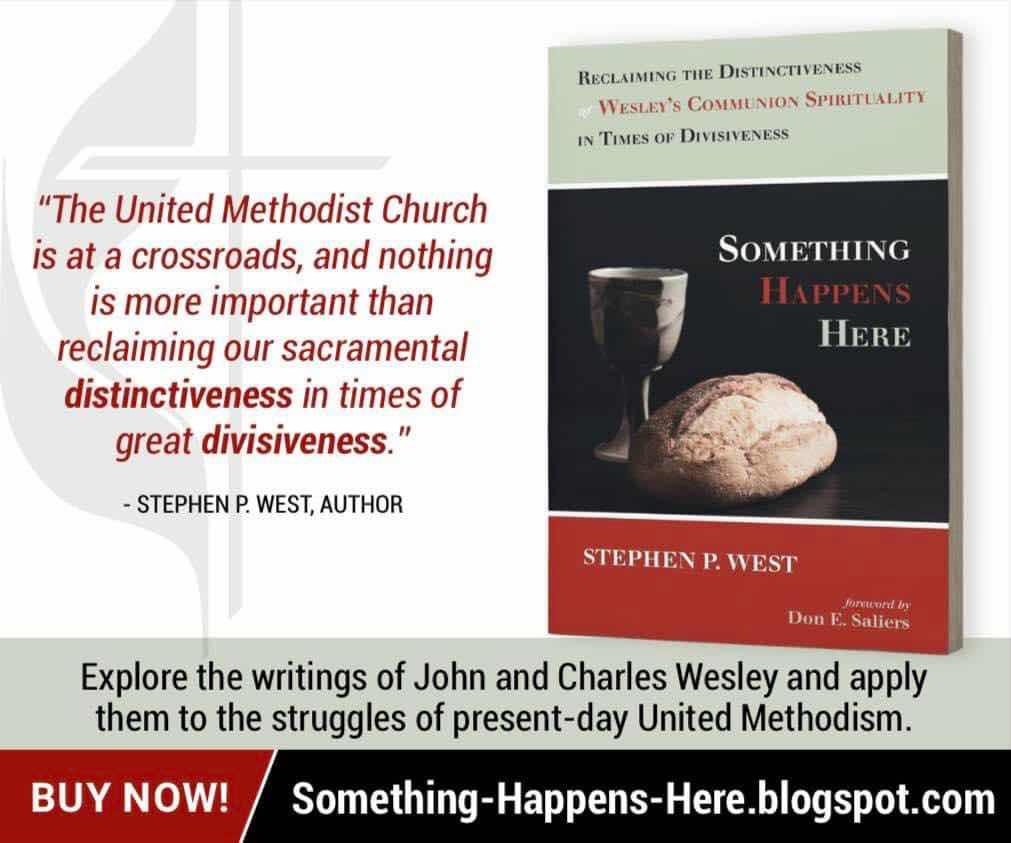
The book titled Something Happens Here: Reclaiming the Distinctiveness of Wesley's Communion Spirituality in Times of Divisiveness has the stated purpose of taking a careful look at John Wesley’s core teaching on the Lord’s Supper. The About this Book introduction explains, “Readers will grapple with the idea that Communion is not just a personal experience with Jesus but a feast that has huge implications for our life together. They will be given language to define themselves against sacramental theology colored by other denominations in their communities. Along the way, they will discover tools to thoughtfully sort through difficult conversations about divisive matters rather than settling into the either-or and ‘us against them’ mentalities that pervade national conversations about culture wars.”

Rev. West, the senior pastor of Jacksonville First UMC (Cheaha District), is descended from multiple generations of Methodist pastors and circuit riders. He has not only a deep belief in the church’s sacramental theology but also a great love of the United Methodist Church. He notes that he wants this book to be a timely resource for United Methodists as the denomination journeys through a season of conflict and division. In that spirit, he says he offers the book as a gift for God’s church and has committed to using 100% of proceeds to go back into promoting the book because he believes “it is so very timely for those who are part of the present journey of the United Methodist Church.”

The book is a scholarly work receiving praise from a variety of United Methodist scholars and authors. Rev. West says, “I hope it will be helpful for the classroom, thought-provoking for church study groups, lifegiving for pastors and church leaders, and accessible for anyone interested in what it means to bind ourselves to Christ and move forward with joy into the future God has in store for us.”

In Something Happens Here West explores the historical background of each core characteristic of Wesley’s communion teachings, finds evidence in the writings of John and Charles Wesley and applies them to the struggles of present-day United Methodism. The unique features of Wesley's communion theology become lenses readers can use as they navigate troubled waters. Chapters include Communion as a Prism, The Mystery of Presence, Experiencing Anew, Become All Flame, Foretaste of Heaven, Grand Channel of Grace, Becoming the Body and Reconnecting. West concludes the book with signs of life emerging as people come back to the Lord's table to move forward into the future.

West writes, “The table is a radical table, because it brings us back to what connects us, which is not agreement or like-minded thinking but community and love-minded thinking. We are bound by our belief, yes, but I’m reminded that in early English, the word 'belief' was pronounced ‘by life.’ How we love those we don’t agree with is the very definition of Christian fellowship.”

The book is available from Amazon or Wipf and Stock Publishers. The book is also available for sale by the author. For a signed copy, see the author or send a check for $22 plus $3 shipping (total $25) to Steve West, 313 2nd Street NE, Jacksonville, AL 36265.

Wednesday, August 31, 2022

Author Interview by United Methodist Insight


I was so honored with an author interview by Cynthia Astle of United Methodist Insight.

It's entitled "'Musical Preacher' Pens Book on Communion as Way to UMC Unity" and it can be found here.

This United Methodist Insight exclusive begins with these words:

"In these days of church turmoil, it may be hard to find someone more in love with the blessings of Methodist heritage than the Rev. Dr. Stephen P. West. That's a good thing, because out of his service as a pastor, his affinity to Charles Wesley's hymns and his doctoral project he has written a book about the heart of Methodism - the sacrament of Holy Communion."

Again, you can find the book on Amazon or Wipf & Stock.

Friday, May 13, 2022

What Would Wesley Say About Leaving the UMC?


“There are those who seem to think they will make the church purer and holier by limiting it to a specific set of legislated opinions.”

ST Kimbrough Jr., renowned Wesley scholar from North Alabama (retired Associate General Secretary for Mission Evangelism for the General Board of Global Ministry), asks what Wesley would say about the splintering minority from the UMC going into the GMC (organizing on May 1) or other offshoot denominations.

What a timely release. Read it at www.stayumc.org.

#stayumc
#BeUMC

Wednesday, November 10, 2021

What’s Distinctive about Wesley’s Communion Spirituality?


This was my presentation “Taste and See” at Bluff Park UMC this morning. What an honor to be back at one of my “home churches.”

It is on FIVE WORDS that describe what is distinctive about Wesley’s communion spirituality:

1. Presence (sure and real)
2. Remembrance (experience anew)
3. Perfection (in love)
4. Foretaste (of heaven)
5. Becoming (the body)


Thursday, September 23, 2021

TULIP and John Wesley


I have created a new "TULIP" handout to use when teaching Wesleyan theology. This is a simplified version of classic Calvinist teaching. Why not share it here with the world?

I've discovered over the years the best way to teach Wesley's "Scripture Way of Salvation" (God's sacred initiative in shaping our lives into fullness through prevenient, justifying, and sanctifying grace) is to start with TULIP. Then I contrast these ideas with the Arminian point of view (free will vs. predestination), and the sheet provides a way to offer Wesley's nuanced approach.

Historically, it makes sense because Wesley's teaching (which is a recovery of eastern Christian spirituality, expressed in more exacting Protestant language) came out of his struggle against Calvinism historically. He was brilliant in what he taught, in my humble opinion!

I say his approach was nuanced because his teachings aren't direct opposite of these teachings, but definitely contrast with them. He taught direct opposites when it comes to the middle three, but his response was nuanced when it came to the first and the last. He believed we are born tainted from our original luster because of original sin, but that our "essential nature" is that we are born in the image of God, not that we are a sinner. Christianity restores us to that original nature, rather than changing us from our original "bad" nature into something else.

Likewise, his response to the Calvinist "once saved always saved" mantra is more nuanced than it is often characterized to be. It should not lead directly to anxiety about whether we are saved or not (the Calvinist critique of Wesley). We don't need to be saved again and again because we fall, heavens no. He also taught ASSURANCE of our salvation, but maintained that God always grants us free will to turn toward God, or away from God. God never forces love. Of course, Wesley's language of "salvation" is rooted in New Testament Greek, and so does not refer simply to whether we have a ticket to heaven or not at the moment of death. It refers to whether we are on the journey of being made whole in Christ. This is part of the mischaracterization of what he means when he indicates we can "fall from grace."